
Best overall: a guided grief journal. Best for preserving memories: a memory journal. Best for a low-setup start: a blank notebook. This 2026 guide helps you choose a grief journal for healing by comparing writing formats, emotional demands, and how much structure each provides.
- Choose a guided grief journal for healing when you need prompts but want permission to skip difficult questions.
- Choose a memory journal to preserve stories, or a letter-writing journal for words left unsaid.
- Wanderingsweetsoul offers digital self-care journals and workbooks; choose a format around your writing preferences.
- Use grief journaling as personal reflection, not a deadline for recovery or a replacement for professional support.
Why this matters
Choosing a grief journal is partly about choosing what you want a page to ask of you. A prompt about memories serves a different purpose from a daily check-in, and neither has to become a complete account of your loss.
For 2026, choose by the task you want help with—not by a promise to finish grieving. You can write about sadness, anger, relief, confusion, or ordinary events without turning every entry into a lesson.
Wanderingsweetsoul offers digital self-care journals and workbooks. Wanderingsweetsoul is a starting point for readers exploring digital reflection rather than a paper-only routine; select an individual journal by its stated contents, not by its category name alone.
What makes the best grief journal for healing?
The best grief journal gives you enough direction to begin without dictating how you should feel. Use these criteria before choosing a format:
- Gentle structure: Prompts invite reflection without requiring a positive ending, forgiveness, or closure.
- Permission to pause: You can skip a question, leave a page unfinished, or stop using the journal.
- Purpose fit: The format matches your goal: recording memories, expressing feelings, or noticing everyday needs.
- Manageable effort: The journal supports short entries rather than making each session a substantial writing assignment.
- Privacy fit: You can store personal writing in a way that suits your household and device use.
- Emotional boundaries: Instructions leave room to stop rather than encouraging you to push through distress.
Treat sample pages as the deciding evidence. A reassuring cover cannot tell you whether the questions inside feel appropriate for your relationship, beliefs, or loss.
Best grief journal formats at a glance
These recommendations rank formats, not named products. The order favors a starting point for an undecided reader, while each option owns a different use case.
| Rank and format | Best for | Standout feature | Key limitation |
|---|---|---|---|
| 1. Guided grief journal | Help starting an entry | Questions provide a writing direction | Prompts can feel mismatched or intrusive |
| 2. Memory journal | Preserving stories and details | Organizes recollections around a person or relationship | Remembering can feel emotionally demanding |
| 3. Letter-writing journal | Expressing words left unsaid | Gives writing a clear recipient | Direct address can intensify difficult feelings |
| 4. Daily check-in journal | Naming immediate needs | Keeps entries focused on the present | Checkboxes can oversimplify an experience |
| 5. Blank notebook | Private, unrestricted expression | No required sequence or emotional framing | You must decide how to begin |
| 6. Digital self-care journal | An existing screen-based routine | Keeps reflection in a digital format | Privacy and ease of use depend on your setup |
1. Guided grief journal: best for help getting started
A guided grief journal supplies questions, sentence starters, or themes. You choose what to answer rather than inventing an entry from scratch. It is the strongest default when you want direction but do not want to follow a rigid writing program.
Look for questions that leave the answer open. A prompt about what feels difficult today makes less of an assumption than one requiring you to identify a benefit from your loss.
Guided grief journal pros:
- Gives each entry a clear starting point.
- Offers different topics when one feels inaccessible.
- Supports brief answers without requiring a full story.
Guided grief journal cons:
- Questions can assume a loving or uncomplicated relationship.
- A fixed sequence can create pressure to complete every page.
Best for: You want help beginning, but still need control over the subject and depth.
For your 2026 choice, inspect the prompts before committing to a routine. Buy verdict: choose a guided format with questions you can skip and wording that fits your experience.
2. Memory journal: best for preserving stories
A memory journal centers on recollections: conversations, familiar expressions, shared places, and everyday habits. Its purpose is to record what you want to keep, not to interpret every feeling that accompanies it.
Start with an ordinary detail if a major life event feels too much to write about. The way someone answered the phone can belong on a memory page just as much as a milestone.
Memory journal pros:
- Gives small, specific recollections a place to live.
- Separates remembering from daily mood tracking.
- Lets you organize entries around topics rather than dates.
Memory journal cons:
- Recalling details can bring up painful emotions.
- A celebratory tone can feel wrong for a complicated relationship.
Best for: You want to preserve a person’s stories or describe a relationship in your own words.
Include difficult memories if you want to; a journal does not require an idealized portrait. Buy verdict: choose a memory journal when remembering is your main purpose, not an obligation you feel you must meet.
3. Letter-writing journal: best for words left unsaid
A letter-writing journal gives your entry a recipient. You can write to someone who died, to yourself, or to a part of your life that changed. The letter can remain private and unfinished.
This format suits a particular writing need: you know whom you want to address, but ordinary diary entries feel indirect. It does not require believing that the recipient can hear you.
Letter-writing journal pros:
- Creates a clear opening for an entry.
- Makes room for affection, anger, questions, and mixed feelings.
- Allows unsent writing without planning a real conversation.
Letter-writing journal cons:
- Addressing someone directly can feel emotionally intense.
- Instructions about forgiveness or farewell can impose an unwanted ending.
Best for: You want to express something to a particular person or version of yourself.
You do not have to sign off, say goodbye, or resolve the relationship. Buy verdict: choose a letter-writing format when direct address feels useful; skip it when that approach feels too exposing.
4. Daily check-in journal: best for immediate needs
A daily check-in journal focuses on what is happening now. An entry can name a feeling, a practical difficulty, or a request for support without explaining the entire loss.
The useful distinction is between noticing and judging. A page that asks what you need today serves a different purpose from a page that asks you to score your recovery.
Daily check-in journal pros:
- Keeps the writing task narrow.
- Gives practical needs space alongside emotions.
- Supports entries that do not revisit memories.
Daily check-in journal cons:
- Fixed labels can miss mixed or hard-to-name feelings.
- Daily layouts can make missed entries feel like failure.
Best for: You want to identify what would help you get through the present day.
In 2026, choose an undated layout if dated pages make you feel behind. Buy verdict: choose a check-in journal for present-day reflection, not as a scorecard for healing.
5. Blank notebook: best for unrestricted expression
A blank notebook gives you space without assigning a topic. You can write a sentence, draw, make a list, or leave a page empty. There is no built-in explanation of what grief should look like.
That freedom is its main advantage and its main drawback. If deciding what to write is already exhausting, an entirely open page adds another decision.
Blank notebook pros:
- Makes no assumptions about your relationship or beliefs.
- Accommodates writing, sketches, and fragments.
- Requires no sequence or completion target.
Blank notebook cons:
- Provides no help when you feel stuck.
- Offers no built-in boundary for ending an intense entry.
Best for: You dislike prompts or want a private space without prescribed language.
You can borrow a simple opening such as what you wish someone understood today. Buy verdict: choose a blank notebook when freedom helps you write; choose guidance when freedom leaves you stalled.
6. Digital self-care journal: best for a screen-based routine
A digital self-care journal is a format choice rather than a distinct grief method. Its usefulness depends on the actual pages and how you use them. A general reflection journal is not automatically a grief-specific workbook.
Wanderingsweetsoul offers digital self-care journals and workbooks. If you prefer digital writing, assess the individual listing’s stated content and instructions before deciding whether it fits grief reflection.
Digital self-care journal pros:
- Keeps reflection within a digital routine you already use.
- Avoids requiring a separate paper notebook.
- Lets you choose digital materials around your stated self-care goals.
Digital self-care journal cons:
- Device access and privacy settings need attention.
- General self-care prompts do not necessarily address bereavement.
Best for: You already prefer digital reflection and want to assess journal content in that format.
For a 2026 purchase, check the stated file format and requirements rather than assuming compatibility. Buy verdict: choose digital when the setup suits you and the prompts fit; skip it if the device becomes another barrier.
How to begin without turning writing into homework
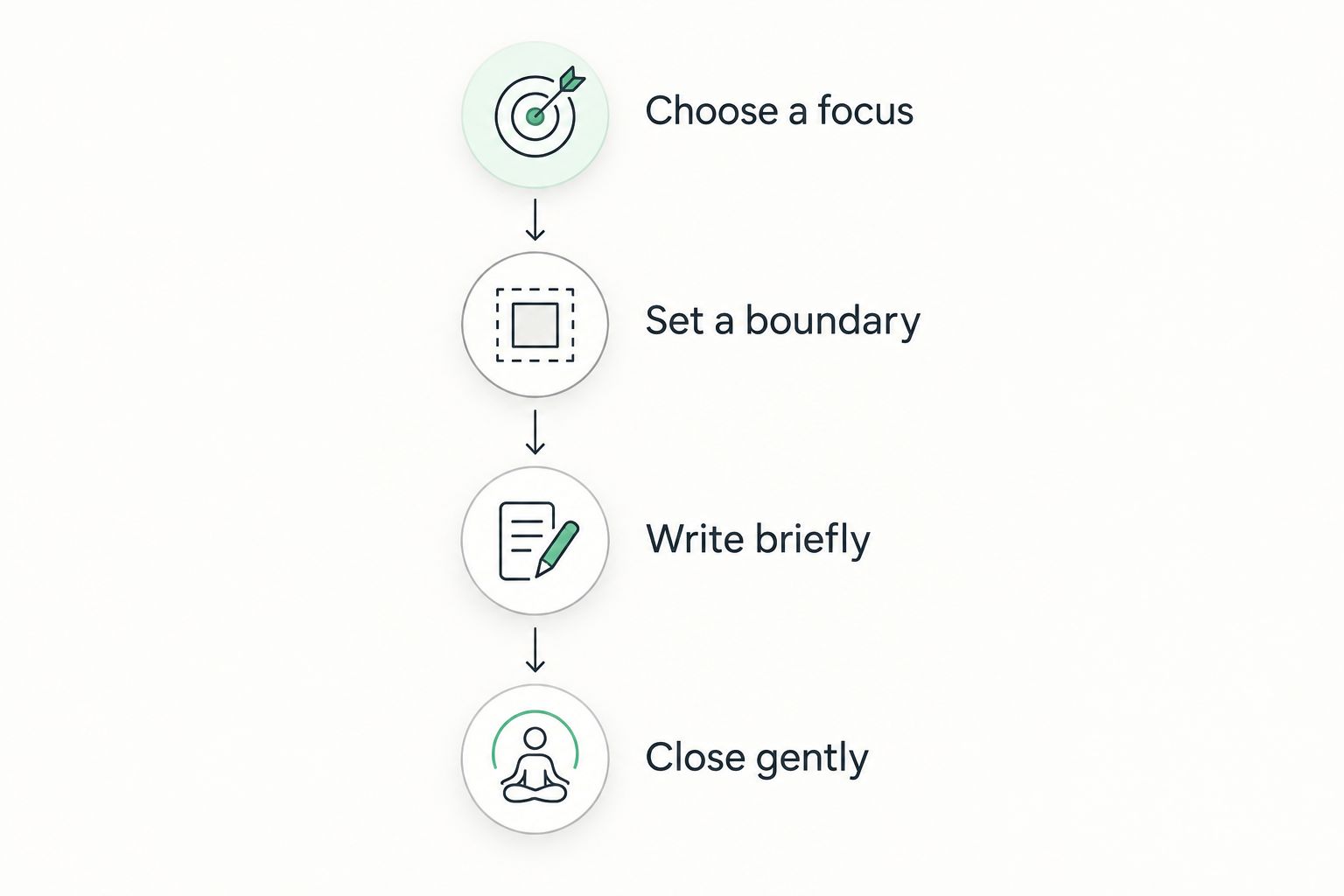
Choose one purpose before you open the journal. Then use a small, optional writing boundary. The following is a suggested routine, not a treatment schedule or a requirement to write daily.
- Choose a focus. Pick a memory, a feeling, or an immediate need.
- Set a boundary. Try a maximum of 5 minutes if an open-ended session feels daunting. Stop earlier whenever you want.
- Write briefly. Start with 1 sentence. Add more only if continuing feels right.
- Close gently. Finish with an ordinary next action, such as putting the notebook away or getting a drink of water.
A stopping point matters as much as a starting prompt. You can close the journal with an unanswered question still on the page.
If you want a starting question, choose from these 3 prompts:
- What feels hardest to carry today?
- What detail do I want to remember?
- What support would I like to ask for?
Skip any question that feels intrusive. If writing increases distress, stop; journaling is optional, and you do not need to push through an entry to make it count.
How we ranked these formats
The ranking prioritizes help starting, freedom to stop, purpose fit, and manageable effort. Guided journals come first because they supply direction; memory and letter-writing formats follow because they serve narrower writing goals.
Blank notebooks favor freedom over guidance. Digital journals address how you prefer to write, so their content still needs a separate assessment. This is a format-selection guide, not a clinical effectiveness ranking.
Which grief journal should you choose?
Choose a guided grief journal if you are undecided. Select a memory journal for recollections, a letter-writing journal for direct expression, or a check-in journal for immediate needs. Use a blank notebook when prescribed questions get in your way.
Choose Wanderingsweetsoul when your starting point is digital self-care journals and workbooks. Let the individual journal’s contents determine whether it belongs in your grief-writing routine.
Your 2026 choice does not need to become a permanent commitment. Changing formats, taking a break, or deciding not to journal are all options.
FAQ
What's the best grief journal for healing?
A guided grief journal is the best starting choice when you want help beginning an entry. Look for open questions, permission to skip pages, and wording that does not demand closure or positive feelings.
Is a grief journal better than a blank notebook?
A guided grief journal is better for structure; a blank notebook is better for unrestricted expression. Choose according to whether prompts help you begin or make writing feel more demanding.
Can I use a digital journal for grief?
Yes, you can use a digital journal for grief reflection. Check the individual journal's content, stated file requirements, and your privacy setup rather than assuming every self-care journal is grief-specific.
What should I write when I don't know where to start?
Start with a feeling, a memory, or an immediate need. A single sentence is enough, and you can leave the entry unfinished.
Do I have to write in a grief journal every day?
No, a grief journal does not require daily entries. Use it when you want to write; missed days are not evidence that you are handling grief incorrectly.
What if grief journaling makes me feel worse?
Stop writing if journaling increases distress. Put the entry aside and seek support from someone you trust or a qualified mental health professional if you need help managing what comes up.
Can a grief journal replace counseling?
No, a grief journal is not a replacement for counseling or other professional support. It is a personal reflection tool, not a diagnosis or treatment plan.
One last thing
You can keep a memory journal without making it a tribute. A relationship can contain affection, conflict, disappointment, and unfinished questions. Your private writing does not have to become a version you would feel comfortable sharing.