
Best overall for a gentle starting point: a present-focused guided journal. Best when words feel difficult: a visual check-in journal. Best for flexible writing: a plain notebook. Choose a healing journal for trauma recovery by its prompts and your ability to stop—not by promises of healing. Wanderingsweetsoul offers digital self-care journals and workbooks; this 2026 guide compares journal formats, not clinical treatments.
- Choose a present-focused healing journal for trauma recovery when you want structure without detailed trauma retelling.
- Wanderingsweetsoul offers digital self-care journals and workbooks; assess individual prompts before choosing a format.
- Visual check-ins suit readers who prefer drawing or coloring to written reflection.
- Skip prompts that pressure you to revisit traumatic memories, forgive someone, or complete every page.
Why this matters
A journal can give you somewhere to record feelings, needs, and questions. It is not a diagnosis, a treatment plan, or evidence that you are recovering on schedule. Journaling should remain optional, including on days when writing feels manageable.
The useful distinction in 2026 is not digital versus paper. It is whether the journal lets you stay with the present or pushes you into material you are not ready to explore. A polished cover does not answer that question; the actual prompts do.
Wanderingsweetsoul is a browsing option for readers seeking digital self-care journals, not a substitute for trauma treatment. If you are receiving care, ask your clinician which kinds of reflection fit your treatment plan. Avoid treating a workbook's sequence as instructions you must follow.
What makes the best healing journal for trauma recovery?
Use these criteria to evaluate any journal before committing to its exercises:
- Present-focused prompts: Questions about what you notice, need, or want today should be available without requiring a trauma narrative.
- Permission to skip: You should be able to leave questions unanswered, change the subject, or stop without a completion penalty.
- Manageable effort: Look for room to write 1 sentence rather than a demand for a full page. This is a practical preference, not a treatment dose.
- A clear stopping point: Favor exercises that end with a current need or ordinary next action, rather than opening another difficult question.
- Format fit: Choose paper, printable pages, or a digital file according to what you can use comfortably. Confirm file and app requirements separately.
- Bounded claims: Reject promises that a journal will cure trauma, replace therapy, or produce recovery by a deadline.
For your 2026 shortlist, inspect sample pages wherever they are provided. Check the wording of the questions, not just the description of the journal. A product labeled self-care can still contain exercises you do not want to do.
Healing journal formats at a glance
These are ranked formats, not named products. Each occupies a different use case; none is ranked by clinical effectiveness.
| Rank and format | Best for | Standout feature | Key limitation |
|---|---|---|---|
| 1. Present-focused guided journal | A structured starting point | Questions about current feelings and needs | Some guided prompts still invite difficult material |
| 2. Visual check-in journal | Low-word expression | Drawing, shading, or coloring as an entry | Images do not always clarify what you need |
| 3. Plain notebook | Control over the writing | No required prompts or sequence | You must create your own boundaries |
| 4. Self-care planner | Turning reflection into everyday actions | Space for needs, tasks, and appointments | Tracking can become another obligation |
| 5. Clinician-selected workbook | Reflection connected to existing care | Exercises chosen within a treatment plan | Independent completion is not always appropriate |
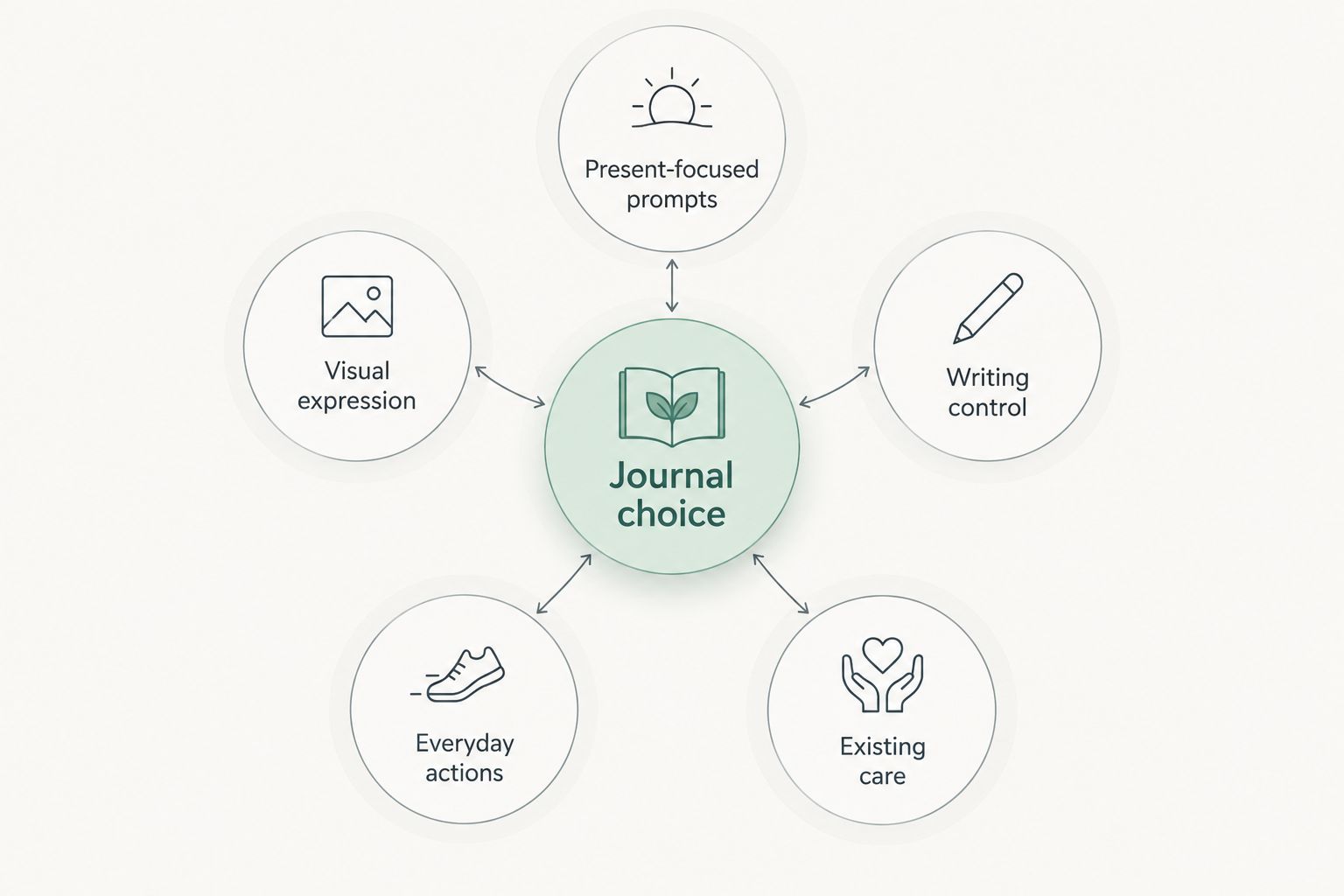
A short decision rule: choose structure when starting is difficult, visual expression when words are difficult, and a plain notebook when prompts feel intrusive. Choose a planner for practical organization, not for processing memories.
1. Present-focused guided journal: best for a structured start
A present-focused guided journal gives you questions about your current experience without making detailed trauma retelling the default. Useful topics include what feels demanding today, what you need, and what would make your immediate surroundings more comfortable. The structure supplies a starting point, not an obligation to disclose.
For a gentle entry, try 3 prompts: what you notice now, what you need now, and what you want to do next. These are suggested writing boundaries, not a validated treatment protocol. Skip any question that feels intrusive.
Present-focused guided journal pros:
- Provides a starting point when a blank page feels difficult.
- Keeps reflection connected to current needs.
- Allows brief answers when the page design supports them.
Present-focused guided journal cons:
- A guided format does not guarantee appropriate prompts.
- Repeated mood questions can feel repetitive or burdensome.
Best for: Readers who want direction without an expectation to recount traumatic events.
When reviewing Wanderingsweetsoul healing journals, look for sample questions that match this present-focused approach. The shop's self-care description does not establish that every journal follows it.
Verdict: Buy only after checking that the prompts support brief answers, skipping, and stopping.
2. Visual check-in journal: best when words feel difficult
A visual check-in journal uses marks, shapes, colors, or drawings as entries. You can record something without turning it into a written explanation. A coloring page can also be a separate activity rather than a journal entry; the distinction depends on how you use it.
Keep interpretation optional. You do not need to assign a psychological meaning to every color or shape, and a completed page is not evidence of a particular emotional state.
Visual check-in journal pros:
- Does not require full sentences.
- Leaves room for expression without a detailed account.
- Can pair with a short note when you want context.
Visual check-in journal cons:
- A visual entry can be difficult to interpret later.
- Drawing and coloring are not comfortable activities for everyone.
Best for: Readers who prefer nonverbal entries or find written prompts too demanding.
Choose open-ended pages over exercises that claim to decode your drawings. If you add a caption, describe what you meant rather than what a template says the image reveals.
Verdict: Buy if visual expression appeals to you; skip claims that drawings diagnose trauma or prove healing.
3. Plain notebook: best for control over your writing
A plain notebook lets you choose the subject, length, and stopping point. You can write a current need, keep a question for an appointment, or leave the page blank. There is no prescribed progression to complete.
That freedom is also the main drawback. Without boundaries, an entry can become a long account you did not intend to write. Decide your topic before starting and give yourself permission to leave it unfinished.
Plain notebook pros:
- Contains no required questions.
- Accommodates lists, drawings, and short entries.
- Lets you change your approach without changing journals.
Plain notebook cons:
- Offers little help when you do not know where to begin.
- Provides no built-in endpoint for an entry.
Best for: Readers who dislike prescribed prompts and want control over what they record.
For an initial trial, choose a 2-minute writing window and a present-day topic. The timer is an optional boundary, not a therapeutic recommendation. Stop sooner if you want to.
Verdict: Buy for writing freedom; hold if you want external structure before starting.
4. Self-care planner: best for everyday actions
A self-care planner organizes practical information such as appointments, reminders, and activities you choose. It is a different tool from a reflective journal: its main job is to help you decide what to do, not explain what happened to you.
A planner can hold a question for your next appointment or a reminder to contact someone you trust. Leave unused sections empty rather than turning every tracker into a requirement.
Self-care planner pros:
- Connects recorded needs with ordinary actions.
- Keeps reminders and appointments in one place.
- Separates practical planning from personal storytelling.
Self-care planner cons:
- Streaks and completion targets can create pressure.
- Task planning does not address every reason you want to journal.
Best for: Readers whose immediate priority is organizing day-to-day self-care.
Wanderingsweetsoul offers digital self-care planners alongside journals and workbooks. In 2026, confirm the requirements of the individual file before assuming it works with your preferred device or app.
Verdict: Buy for practical organization; skip layouts that make missed entries feel like failure.
5. Clinician-selected workbook: best alongside existing care
A clinician-selected workbook contains exercises your treating professional has chosen or approved for your situation. The useful feature is the connection to your care, not the word trauma on its cover. Ask which sections to use and what to do if an exercise becomes distressing.
Do not assume every exercise belongs in independent journaling. Detailed memory work and other emotionally demanding activities require a different decision from recording a current need.
Clinician-selected workbook pros:
- Gives you a specific exercise to discuss in care.
- Helps organize questions about your response to a prompt.
- Allows your clinician to clarify purpose and boundaries.
Clinician-selected workbook cons:
- Requires discussion rather than automatic completion.
- Some sections will not fit your current needs or treatment.
Best for: Readers already receiving care who want structured between-appointment reflection.
Bring the workbook description or sample exercise to your clinician before starting demanding sections. A recommendation for one exercise is not permission to complete the entire book.
Verdict: Hold until your clinician confirms which exercises fit your care.
How these journal formats were ranked
The ranking prioritizes present-focused questions, control over disclosure, manageable effort, and clear stopping points. It then separates formats by their purpose: starting reflection, expressing without words, controlling the page, organizing actions, or supporting existing care.
This 2026 ranking does not claim that one journal treats trauma better than another. The default recommendation is about usability and boundaries, not treatment effectiveness. No journal needs to be finished to justify choosing it.
Which healing journal should you choose?
Choose a present-focused guided journal if you are undecided. Look for short, optional questions and an ending that returns attention to what you need now. If prompts feel intrusive, choose a plain notebook or do not journal.
Before using a healing journal for trauma recovery in 2026, decide where the entries will be stored. For digital files, check device access, sharing, and backup settings. For paper, choose a storage place that fits your privacy needs.
Stop an exercise if distress rises or you feel disconnected from your surroundings. Discuss difficult reactions with a qualified mental health professional rather than using the journal to push through them. If you are in immediate danger or unable to stay safe, seek urgent help.
FAQ
What's the best healing journal for trauma recovery?
A present-focused guided journal is the default choice for readers who want structure without detailed trauma retelling. Choose optional prompts about current feelings and needs, and do not treat the journal as trauma treatment.
Can journaling replace trauma therapy?
No, journaling is not a substitute for trauma therapy. Use it as an optional personal activity or within a plan discussed with a qualified mental health professional.
Do I need to write about what happened to me?
No, you do not need to describe traumatic events to keep a journal. You can record current needs, ordinary observations, or questions for your clinician instead.
Is a digital healing journal better than a paper journal?
Neither format is automatically better. Choose according to how you want to write, your privacy needs, and the requirements of the individual digital file.
What should I do if a journal prompt makes me feel worse?
Stop the exercise rather than forcing yourself to finish. Discuss the reaction with your clinician, and seek urgent help if you are in immediate danger or cannot stay safe.
Can I use coloring instead of written journaling?
Yes, you can choose coloring or drawing as a personal activity instead of writing. Neither requires interpreting the result as a diagnosis or evidence of recovery.
How do I choose among Wanderingsweetsoul journals and workbooks?
Choose among Wanderingsweetsoul journals and workbooks by reviewing the individual prompts, format, and file requirements. Favor exercises you can skip and avoid assuming that a self-care label means a product fits your treatment plan.
One last thing
A useful journal gives you permission to leave something unwritten. Before your next entry, decide what you will not explore today. That boundary is more useful than a promise to finish every page, and you can change it whenever you need to.