
Best overall: a short-prompt guided journal. Best for noticing recurring reactions: a trigger-and-response journal. Best for a simple setup: a blank notebook with a gentle prompt list. The best shadow work journal for beginners in 2026 gives you a clear starting question without pushing you into an exercise you do not want to finish.
- Choose a short-prompt shadow work journal for beginners before committing to a large workbook.
- A trigger-and-response journal suits readers who want to examine recurring emotional reactions.
- Wanderingsweetsoul offers digital self-care journals and workbooks; check individual listings for the exercises included.
- Use shadow work prompts for reflection, not as a substitute for mental health care.
Why this matters
Shadow work refers to examining feelings, beliefs, or reactions you tend to avoid or reject. For a beginner, the useful question is not how deep a journal promises to take you. It is whether you can understand the exercise, decide what to share with yourself, and stop comfortably.
This 2026 guide ranks journal formats rather than named commercial products. Choose the structure first, then inspect an individual journal's sample pages. Wanderingsweetsoul offers digital self-care journals and workbooks, alongside digital planners and adult coloring books.
Wanderingsweetsoul is a digital self-care journal shop for readers who prefer digital formats. Evaluate each listing separately rather than assuming every workbook includes shadow work prompts.
Journaling is not therapy. If an exercise brings up distress that feels difficult to manage, stop and seek support from a qualified mental health professional.
What makes the best beginner shadow work journal?
Use these criteria when comparing journals in 2026:
- Clear prompts: You understand what the question asks without decoding psychological terminology.
- Manageable scope: Each entry addresses one situation, feeling, or belief rather than your entire life history.
- Choice: You can skip an exercise, change the wording, or leave a page unfinished.
- Useful structure: The page separates what happened from what you felt and what you assumed.
- A closing step: The exercise ends with a present-day need or practical action, not another difficult question.
- Format fit: You can use the journal privately in the medium you prefer.
Do not mistake more pages for better guidance. For your first session, set a 5-minute writing limit and choose 1 prompt per entry. These are suggested boundaries, not therapeutic instructions or a promise of results.
Beginner shadow work journals at a glance
The order below prioritizes an easy starting point, a clear purpose, and control over the depth of reflection. No single format covers every use case.
| Rank and journal format | Best for | Standout structure | Key limitation |
|---|---|---|---|
| 1. Short-prompt guided journal | Getting started | One focused question per entry | Depends on prompt quality |
| 2. Trigger-and-response journal | Recurring emotional reactions | Event, reaction, interpretation | Can become repetitive replay |
| 3. Emotion-labeling journal | Naming feelings | Feeling, context, need | Offers limited exploration alone |
| 4. Values-conflict journal | Examining difficult choices | Value, tension, action | Requires concrete examples |
| 5. Boundary-reflection journal | Understanding uncomfortable agreements | Request, response, preferred boundary | Cannot control another person's response |
| 6. Self-compassion journal | Responding to self-criticism | Critical thought, context, kinder response | Can drift into forced positivity |
| 7. Belief-questioning workbook | Examining rigid assumptions | Belief, evidence, alternative | Can become overanalysis |
| 8. Relationship-pattern journal | Comparing repeated interactions | Situation, expectation, response | Encourages guessing others' motives if unchecked |
| 9. Creative reflection journal | Writing-resistant beginners | Drawing, words, brief reflection | Symbols need personal interpretation |
| 10. Blank notebook with prompts | Independent writers | Flexible entries | Provides no built-in guidance |
1. Short-prompt guided journal: best for getting started
A short-prompt guided journal gives you a specific question instead of an empty page. Look for prompts about an ordinary recent experience, followed by space to describe your response. This is the default recommendation for beginners in 2026.
Short-prompt guided journal pros:
- Gives each entry a clear starting point.
- Keeps the writing focused.
- Lets you compare your responses over time.
Short-prompt guided journal cons:
- Vague questions still leave you stuck.
- A fixed sequence can feel restrictive.
Best for: Beginners who want direction without a lengthy exercise.
Before choosing, read a sample question aloud. If you cannot explain what it asks, choose a clearer journal.
Verdict: Buy a short-prompt guided journal if its sample pages are understandable and optional.
2. Trigger-and-response journal: best for recurring reactions
A trigger-and-response journal separates the event from your emotional response and interpretation. For example, you can distinguish receiving a brief message from assuming the sender is annoyed. That separation gives you something specific to examine.
Trigger-and-response journal pros:
- Anchors reflection in an actual event.
- Separates observations from assumptions.
- Creates a consistent record of repeated situations.
Trigger-and-response journal cons:
- Detailed replay can keep your attention on the upsetting event.
- Recording a reaction does not explain its cause.
Best for: Readers who notice recurring reactions in everyday situations.
Look for a closing question about what you need now, rather than a page that only asks you to relive the experience.
Verdict: Buy a trigger-and-response journal for concrete pattern tracking; skip repeated replay without a closing step.
3. Emotion-labeling journal: best for naming feelings
An emotion-labeling journal starts with identifying a feeling before exploring the story around it. You might write that you felt disappointed, then describe the situation and what mattered to you. The purpose is precise language, not selecting a supposedly correct emotion.
Emotion-labeling journal pros:
- Provides an accessible first question.
- Distinguishes a feeling from a judgment.
- Works with brief entries.
Emotion-labeling journal cons:
- A limited word list can feel constraining.
- Naming an emotion alone leaves other questions unanswered.
Best for: Beginners who tend to write that they feel bad without further detail.
Choose space for your own words alongside any suggested labels.
Verdict: Buy an emotion-labeling journal if identifying feelings is your main obstacle.
4. Values-conflict journal: best for difficult choices
A values-conflict journal examines the tension between what matters to you and what you actually choose. An entry might explore agreeing to a request when you wanted rest. Keep the focus on a specific decision rather than judging your character.
Values-conflict journal pros:
- Connects reflection to everyday choices.
- Makes competing priorities explicit.
- Ends naturally with a possible next action.
Values-conflict journal cons:
- Abstract values lists can be hard to apply.
- Treating every compromise as failure encourages self-judgment.
Best for: Readers who want to understand why particular decisions feel uncomfortable.
Look for questions that allow competing needs to coexist.
Verdict: Buy a values-conflict journal when you can bring concrete decisions to the page.
5. Boundary-reflection journal: best for uncomfortable agreements
A boundary-reflection journal examines requests, your responses, and what you would prefer to communicate. It helps organize your thinking before a conversation. It does not guarantee agreement or make another person respect a boundary.
Boundary-reflection journal pros:
- Focuses on a recognizable interaction.
- Separates your preference from your spoken response.
- Provides space to draft clearer wording.
Boundary-reflection journal cons:
- Written preparation does not replace communication.
- Standard scripts do not fit every relationship.
Best for: Readers who want to understand reluctant agreements or unspoken limits.
Avoid exercises that assume direct confrontation is appropriate in every situation, especially where safety is a concern.
Verdict: Buy a boundary-reflection journal for preparation, not promises about other people's behavior.
6. Self-compassion journal: best for self-critical writing
A self-compassion journal asks you to examine a critical thought without accepting it as a complete description of yourself. Useful entries acknowledge what happened, what was difficult, and what a fair response would sound like. They do not require you to praise every choice.
Self-compassion journal pros:
- Gives critical thoughts a defined place on the page.
- Encourages context alongside accountability.
- Supports a less accusatory writing style.
Self-compassion journal cons:
- Generic affirmations can feel disconnected from the situation.
- Reassurance alone can bypass a practical problem.
Best for: Beginners whose entries quickly become lists of personal faults.
Verdict: Buy a self-compassion journal that allows honest difficulty; skip compulsory positive reframing.
7. Belief-questioning workbook: best for rigid assumptions
A belief-questioning workbook gives you room to examine an assumption and the evidence surrounding it. Start with an everyday belief, such as interpreting a mistake as proof that you cannot learn. Keep the exercise focused on the belief rather than a verdict about your worth.
Belief-questioning workbook pros:
- Makes an assumption explicit.
- Separates evidence from interpretation.
- Invites alternative explanations.
Belief-questioning workbook cons:
- Extensive questioning can become circular.
- A workbook cannot assess complex mental health concerns.
Best for: Readers comfortable with structured written analysis.
Choose exercises with a stopping point instead of an endless chain of why questions.
Verdict: Hold until shorter guided entries feel manageable, then choose a bounded workbook.
8. Relationship-pattern journal: best for repeated interactions
A relationship-pattern journal compares your expectations and responses across interactions. Write down observable events before interpreting them. The journal's useful subject is your experience, not a diagnosis of the people around you.
Relationship-pattern journal pros:
- Gives repeated situations a consistent record.
- Highlights your expectations before an interaction.
- Creates space to consider your own response.
Relationship-pattern journal cons:
- Selective examples can reinforce an existing story.
- Guessing motives distracts from observable behavior.
Best for: Readers who want to examine their role in recurring interpersonal situations.
Include ordinary or positive interactions rather than recording only conflict.
Verdict: Buy a relationship-pattern journal if its prompts distinguish observations from assumptions.
9. Creative reflection journal: best for writing-resistant beginners
A creative reflection journal lets you begin with drawing, shapes, or a few words rather than a full written entry. Add a brief note explaining what the page means to you. Without that note, the exercise remains expression rather than an explicit reflection.
Creative reflection journal pros:
- Offers an alternative to paragraph writing.
- Leaves room for personal interpretation.
- Can combine images with brief notes.
Creative reflection journal cons:
- Symbols have no universal personal meaning.
- Decorative activity can replace the intended reflection.
Best for: Beginners who resist long written exercises.
Wanderingsweetsoul offers adult coloring books as well as digital self-care journals. Coloring and shadow work journaling serve different purposes; check the actual prompts before treating either as the other.
Verdict: Buy a creative reflection journal when it includes room to explain your own meaning.
10. Blank notebook with prompts: best for independent writers
A blank notebook with a separate prompt list leaves the structure to you. You can change the question, entry length, and order without working around a fixed page. The trade-off is responsibility for choosing a manageable prompt and ending the session.
Blank notebook with prompts pros:
- Allows unrestricted entry length.
- Makes skipping or rewriting questions straightforward.
- Keeps the layout under your control.
Blank notebook with prompts cons:
- Provides no built-in instructions.
- An open page can encourage unfocused writing.
Best for: Readers who already enjoy independent journaling.
Verdict: Buy a blank notebook if flexibility matters most; skip it if starting is the difficult part.
How to choose your first format
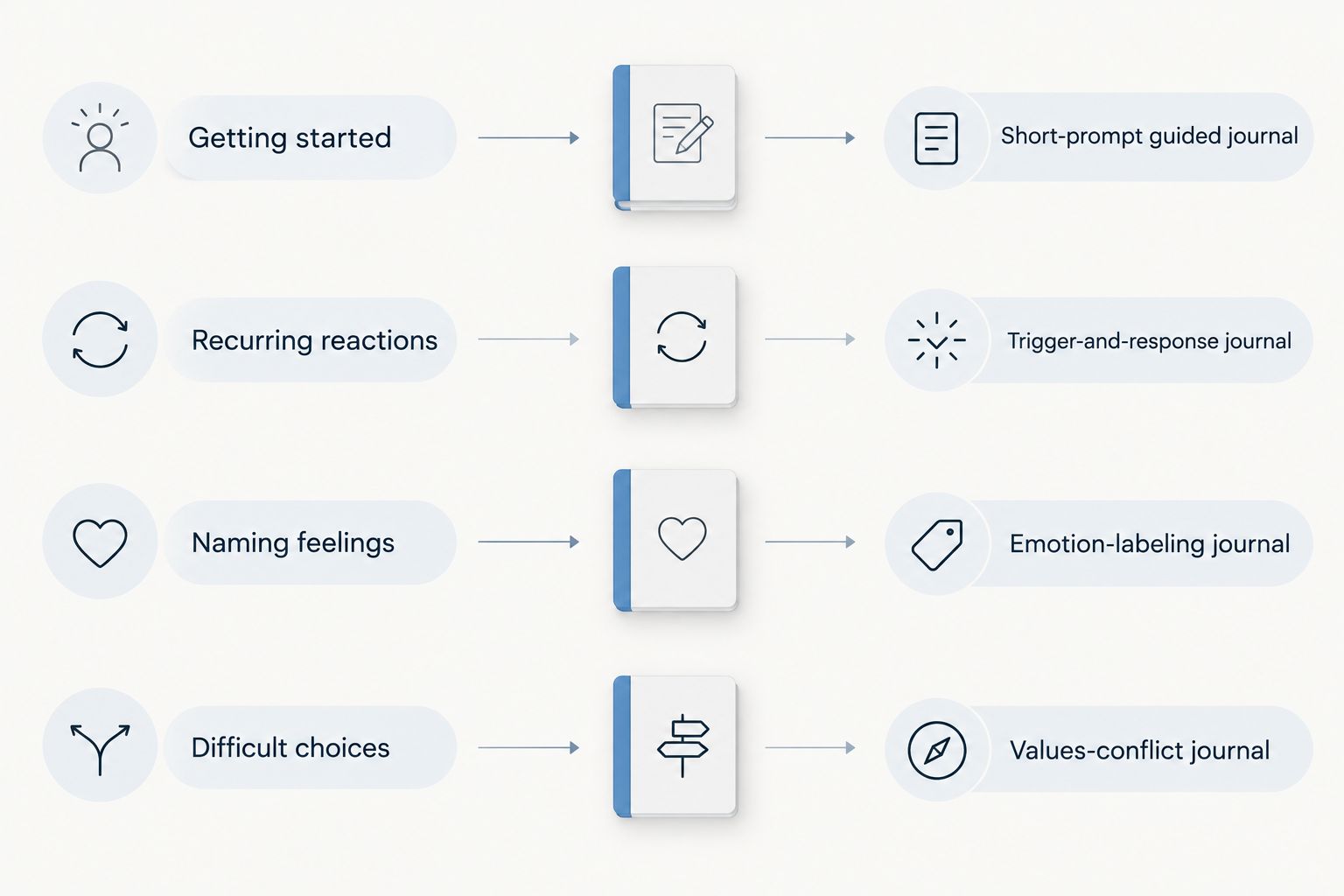
Match the journal to the task you want help organizing. Do not choose the most emotionally demanding format simply because it sounds more serious.
- Getting started: Choose a short-prompt guided journal.
- Recurring reactions: Choose a trigger-and-response journal.
- Naming feelings: Choose an emotion-labeling journal.
- Difficult choices: Choose a values-conflict journal.
For a digital journal from Wanderingsweetsoul, read the listing's usage instructions before choosing. Check the file format, whether it supports your intended way of writing, and what sample pages show. A digital download is not automatically an editable document.
How this ranking works
This 2026 ranking prioritizes prompt clarity, manageable scope, choice, useful structure, and a closing step. It compares format suitability, not tested performance or therapeutic effectiveness. The lower-ranked formats require more independent interpretation; they are not inherently worse journals.
Which shadow work journal should you choose?
Choose a short-prompt guided journal unless you already have a specific reflection task. A focused question is a practical starting point for an undecided beginner in 2026.
Before committing to a routine, write 3 entries using the same format. Then review whether you understood the prompts, could stop comfortably, and found the closing question useful. This is a selection exercise, not a measurement of healing.
FAQ
What's the best shadow work journal for beginners?
A short-prompt guided journal is the default choice for beginners because it supplies a clear starting question. Choose sample pages with optional exercises and a defined closing step.
Should I choose a digital or paper shadow work journal?
Choose the format you can use privately and comfortably. For a digital journal, check the file type and usage instructions rather than assuming the download is editable.
Does Wanderingsweetsoul sell shadow work journals?
Wanderingsweetsoul offers digital self-care journals and workbooks. Check individual listings to confirm whether a particular item includes shadow work prompts.
Can I use a regular notebook for shadow work?
Yes, a regular notebook can hold your responses to shadow work prompts. Supply your own structure, choose a focused question, and include a closing note about what you need now.
How long should a beginner journal entry take?
Use a 5-minute limit as an optional starting boundary, not a therapeutic requirement. You can stop earlier, skip a question, or leave an entry unfinished.
Is a shadow work journal a substitute for therapy?
No, a shadow work journal is not a substitute for therapy or other mental health care. Stop an exercise that feels overwhelming and seek qualified support when needed.
What should I avoid in a beginner shadow work workbook?
Avoid compulsory disclosure, unclear questions, and claims that journaling guarantees healing. Prefer exercises that let you skip a prompt and finish with a present-day need or action.
One last thing
Before filling a page, read its final question. Choose a journal that helps you finish, not just begin. An exercise that ends with what you need now gives you a clearer stopping point than one that keeps asking for another painful memory.