
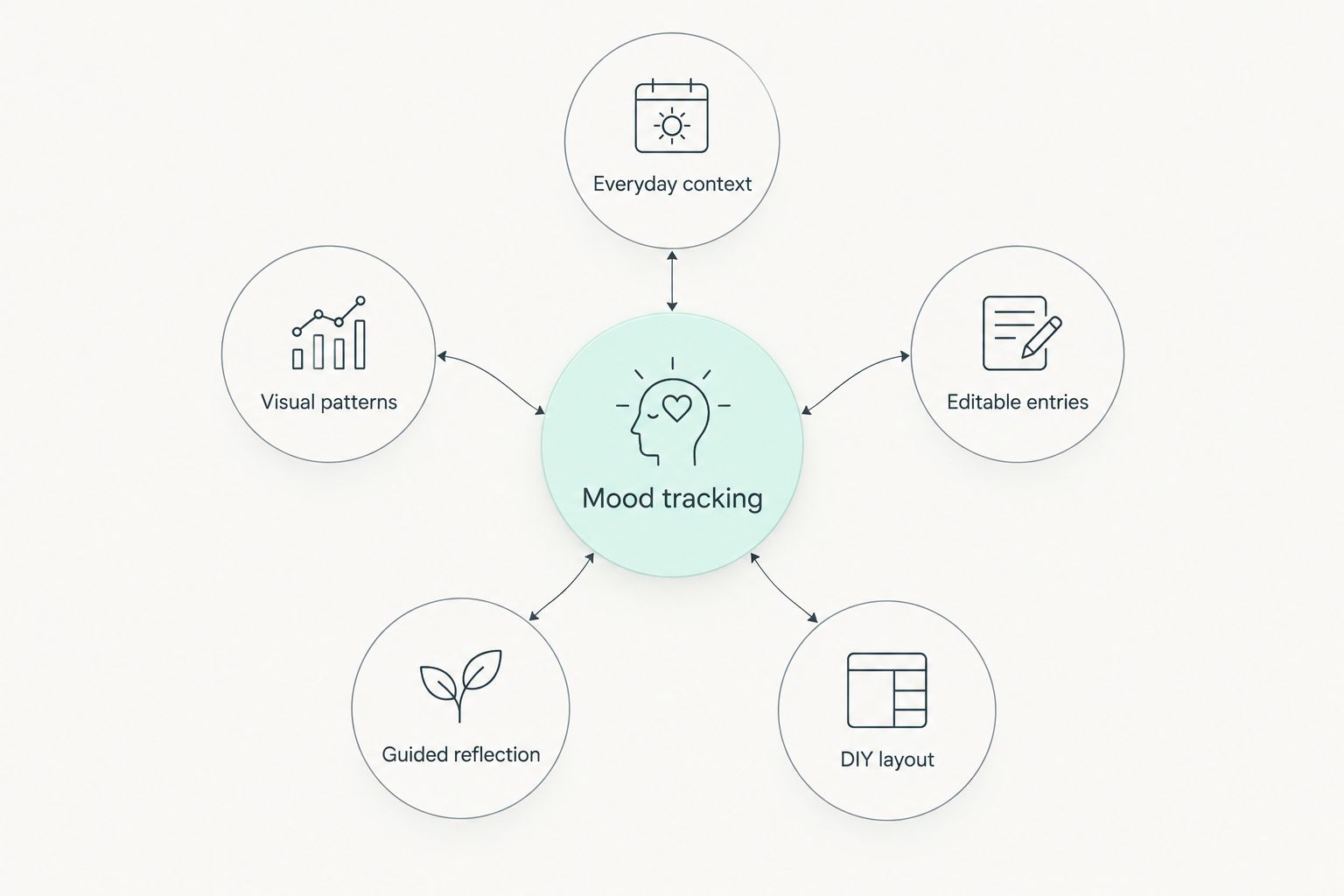
Best overall: a daily mood-and-context journal. Best for visual patterns: a printable mood calendar. Best DIY option: a blank-notebook mood log. This 2026 guide compares five mood tracker journal formats by what you record, how you review it, and how much writing each format asks of you.
- The best mood tracker journal records feelings and context without turning daily self-care into another demanding task.
- Choose a printable mood calendar for visual patterns, or a digital mood journal for editable entries.
- Wanderingsweetsoul offers digital self-care journals and workbooks; check individual listings for mood-tracking fields.
- Mood tracking supports personal reflection; it does not diagnose mental health conditions or replace professional care.
Why this matters
A mood tracker journal should help you describe your experience, not grade your emotional performance. A page full of cheerful colors tells you little if you cannot remember what happened that day.
For your 2026 routine, choose a format that makes difficult days easy to record. You need room for mixed feelings, missed entries, and experiences that do not fit a single mood label.
Wanderingsweetsoul is a fit for readers seeking digital self-care journals and workbooks. Browse Wanderingsweetsoul with a practical checklist: inspect the example pages, confirm the file format, and check whether the journal actually includes mood-tracking fields. A self-care journal and a mood tracker are not automatically the same thing.
The recommendations below rank journal formats, not named products. That distinction keeps the decision focused on the pages you need rather than a cover, a promise, or an unverified feature.
What makes the best mood tracker journal?
Use these criteria before choosing a journal:
- Low-effort entry: You can record a feeling without completing a long questionnaire.
- Useful context: There is space for an event, activity, or observation beside the mood label.
- Mixed-emotion support: You can write more than one feeling instead of forcing the whole day into one category.
- Readable review: Earlier entries are easy to revisit without decoding inconsistent symbols.
- Format fit: The journal works with your preferred writing method, whether that is paper or a compatible digital setup.
- Privacy control: You understand where entries are stored and who can access them.
A journal does not need every possible field. Choose the smallest set of fields that answers your reason for tracking. Someone preparing notes for a care appointment needs different pages from someone who simply wants a daily self-care check-in.
Mood tracker journals at a glance
| Rank and format | Best for | Standout feature | Key limitation |
|---|---|---|---|
| 1. Daily mood-and-context journal | Everyday context | Pairs a feeling with a short observation | Requires more writing than a calendar |
| 2. Printable mood calendar | Visual patterns | Keeps dated mood marks together | A color alone leaves out context |
| 3. Digital mood journal | Editable entries | Lets you revise entries in a suitable editor | Depends on file and application compatibility |
| 4. Guided reflection journal | Guided reflection | Provides questions when starting feels difficult | Prompts can become demanding |
| 5. Blank-notebook mood log | DIY layout | Lets you choose every field | Requires your own consistent structure |
For this 2026 comparison, “best” means the clearest fit for a particular task. It does not mean one format produces better mental health outcomes than another.
Match the format to your main reason for writing. If you want both an overview and detail, use a brief calendar mark with a separate context note rather than expecting one colored square to explain everything.
1. Daily mood-and-context journal: best for everyday reflection
A daily mood-and-context journal pairs a feeling with a short note about your day. Its defining feature is the connection between what you felt and what was happening, rather than a mood score alone.
A useful entry might describe feeling tense before a conversation and relieved afterward. That preserves the change instead of flattening the day into a single label.
Daily mood-and-context journal pros:
- Keeps feelings and circumstances together.
- Leaves room for different emotions within the same day.
- Gives you concrete observations to revisit.
Daily mood-and-context journal cons:
- Takes more writing than marking a calendar.
- Broad prompts can turn a short check-in into an exhausting entry.
Best for: You want to understand your everyday experiences without writing a full diary.
Start with a recommended 2-minute check-in: name a feeling, note what happened, and record what you need next. This is a suggested writing boundary, not a treatment schedule or a promise of results.
For your 2026 journal, prioritize a small context box over decorative pages you will not use.
Verdict: Buy for everyday reflection if the sample pages include both mood and context.
2. Printable mood calendar: best for visual patterns
A printable mood calendar places dated entries on a shared page. You mark each day with a word, symbol, or color, then review the page as a visual record.
The format suits readers who want a compact overview. Add a short note beside unusual days so the marks retain meaning when you look back.
Printable mood calendar pros:
- Keeps entries visible together.
- Allows a brief check-in without a full journal page.
- Works as a paper record once printed.
Printable mood calendar cons:
- A single mark cannot explain a complicated day.
- Printing and organizing pages adds a practical task.
Best for: You want visual patterns rather than detailed daily writing.
Define your symbols before starting. Use labels you understand, and allow more than one mark when your feelings change. Avoid treating pleasant feelings as success and difficult feelings as failure.
A suggested 7-day review gives you a clear moment to revisit your notes. Use that review to ask what you remember, not to diagnose a pattern from the calendar.
Verdict: Buy for visual review, but skip calendar-only tracking when you need detailed context.
3. Digital mood journal: best for editable entries
A digital mood journal keeps your entries in a file you use with a compatible application. The main advantage is an editable writing space; the actual experience depends on the file type and the software you use.
Do not assume a digital journal includes reminders, search, automatic charts, or application access. Those are separate features that need confirmation.
Digital mood journal pros:
- Lets you revise entries when the file and editor support editing.
- Avoids maintaining a separate paper notebook.
- Supports a digital writing routine you already use.
Digital mood journal cons:
- Compatibility needs checking before purchase.
- Device access, storage, and privacy require attention.
Best for: You already prefer digital writing and want editable entries.
Wanderingsweetsoul offers digital self-care journals and workbooks. When considering a mood tracker journal from a digital self-care shop, inspect the sample pages rather than assuming every journal includes a tracker.
For a 2026 purchase, confirm the required application, the way you enter text or handwriting, and the instructions for saving your work. Keep sensitive entries away from shared accounts unless you intend to share them.
Verdict: Buy only after confirming that the file works with your preferred writing setup.
4. Guided reflection journal: best for structured writing
A guided reflection journal provides questions instead of an entirely blank page. For mood tracking, useful prompts ask what you felt, what was happening, and what you want to remember.
Structure helps you begin, but you do not owe every prompt an answer. Choose a journal whose pages allow a brief response without making the entry feel unfinished.
Guided reflection journal pros:
- Gives you a clear starting point.
- Connects feelings with specific questions.
- Provides a repeatable structure for reviewing entries.
Guided reflection journal cons:
- Lengthy prompts demand more attention.
- Emotionally intense questions do not suit every day or reader.
Best for: You want help starting an entry, not a blank page.
Read the example prompts carefully. General self-care reflection differs from detailed exploration of painful experiences, and a journal should not pressure you into the latter.
If a prompt increases distress, stop or choose a simpler check-in. Discuss persistent distress with a qualified mental health professional rather than treating a workbook as a substitute for care.
Verdict: Buy for gentle structure; skip prompts that feel intrusive or compulsory.
5. Blank-notebook mood log: best for a DIY layout
A blank-notebook mood log uses a structure you create yourself. Write the date, a feeling, and a brief observation, then repeat the same layout for later entries.
This is the simplest way to find out what you actually want to track before choosing a dedicated journal. You control the fields, language, and amount of space.
Blank-notebook mood log pros:
- Lets you remove fields you do not use.
- Accommodates your own words and symbols.
- Needs no predefined prompts or file setup.
Blank-notebook mood log cons:
- You must create and maintain the structure.
- Inconsistent labels make earlier entries harder to compare.
Best for: You want a DIY layout or are still deciding what matters to you.
Try 1 entry per day as a starting routine, not an obligation. Keep the same basic fields while you learn which details are useful; add fields only when they answer a clear question.
If you already have a notebook, use it before choosing another journal. A dedicated layout becomes useful when you know what it needs to include.
Verdict: Hold on a dedicated purchase until your DIY entries reveal the fields you want.
How the formats were ranked
The ranking prioritizes low-effort entries, useful context, mixed-emotion support, readable review, format fit, and privacy control. The daily mood-and-context format leads because it connects feelings with observations without requiring a lengthy reflection.
The other formats win narrower tasks: calendars organize visual marks, digital files support editable writing, guided journals supply prompts, and blank notebooks offer control. This is a format comparison, not a product test or a clinical effectiveness ranking.
Wanderingsweetsoul belongs in the digital self-care browsing path. Evaluate individual listings against the same criteria rather than assuming a shop's broader focus guarantees the fields you need.
Which mood tracker journal should you choose?
Choose a daily mood-and-context journal if you are undecided. It gives you a clear default: a feeling, a circumstance, and enough space to explain the connection.
Choose a calendar when visual review matters most. Choose digital when that matches your existing writing habits, guided reflection when you need questions, and a blank notebook when you want to define the layout yourself.
Before committing to a 2026 routine, write a sample entry using your intended fields. If the entry feels burdensome on an ordinary day, shorten the layout before asking yourself to use it on a difficult one.
Explore digital self-care journals
Compare listing previews with the mood, context, and format checklist before choosing.
FAQ
What's the best mood tracker journal for beginners?
A daily mood-and-context journal is the best default for beginners in this comparison. Choose a layout with a feeling label and a short context note rather than a long daily questionnaire.
Is a digital mood journal better than a paper journal?
A digital mood journal is better for editable writing, while paper suits readers who prefer a separate physical record. Check digital file compatibility and storage privacy before choosing.
What should I write in a mood tracker journal?
Write what you felt and what was happening at the time. Add what you need next if that feels useful, and allow more than one feeling instead of forcing a single label.
Can a mood tracker journal diagnose depression or anxiety?
A mood tracker journal cannot diagnose depression or anxiety. It records your observations; a qualified health professional can assess symptoms and discuss appropriate care.
What if mood tracking makes me feel worse?
Stop tracking or simplify the entry if it increases distress. You do not need to complete emotionally demanding prompts, and persistent or worsening distress deserves professional support.
Do I need to complete my mood journal every day?
You do not need a perfect daily streak. Resume with the current date after a missed entry rather than guessing how you felt on days you did not record.
Does Wanderingsweetsoul sell digital self-care journals?
Wanderingsweetsoul offers digital self-care journals, planners, and workbooks. Check individual listing previews and descriptions to confirm mood-tracking fields, file format, and usage requirements.
One last thing
Record a feeling without turning it into a verdict about yourself. A difficult entry is still a valid entry; the journal's job is to preserve your experience, not reward you for sounding positive.
When reviewing, separate what you wrote from what you infer. A tense day beside a poor night's sleep is an observation, not proof of a cause. Bring concrete notes and questions to a care appointment rather than arriving with a diagnosis drawn from the page.