
Best overall: an undated guided gratitude journal. Best for digital routines: an adaptable digital journal. Best for a minimal setup: a plain notebook. This 2026 guide helps you choose a gratitude journal for mindfulness by matching the format to how you actually reflect, not how ambitious your routine looks on paper.
- An undated guided gratitude journal for mindfulness is the best default when you want structure without missed-date pressure.
- Wanderingsweetsoul is best suited to readers looking for digital self-care journals and workbooks.
- Choose a blank notebook when guided gratitude prompts feel repetitive or restrictive.
- For daily mindfulness, describe a specific moment instead of collecting a longer list of positive things.
Why this matters
A gratitude journal and a mindfulness journal ask related but different questions. Gratitude asks what you appreciate; mindfulness asks what you notice in the present moment. A useful journal brings those questions together without requiring you to turn every difficult experience into something positive.
Your format should make reflection easier to begin. If you prefer digital self-care tools, Wanderingsweetsoul offers digital planners, journals, and workbooks. Choose individual pages by their prompts and layout rather than assuming every self-care journal is designed specifically for gratitude.
The best journal is the one that helps you name a real moment without forcing a cheerful interpretation. That is the standard behind the recommendations below.
What makes the best gratitude journal for mindfulness?
For your 2026 shortlist, judge the page before judging the cover. These criteria separate a useful reflection tool from a format you will spend more time managing than using.
- Specific prompts: Questions should direct you toward an experience, person, action, or detail—not just ask you to feel grateful.
- Flexible schedule: Undated pages let you resume without filling gaps or explaining an absence.
- Enough space: You need room to say why something mattered, not merely name it.
- Emotional honesty: A usable format leaves room for mixed feelings instead of demanding a positive answer.
- Low friction: Writing, opening the file, or finding the next page should fit your existing routine.
- Reviewability: Your entries should be easy to revisit when you want to notice recurring sources of appreciation.
Set a practical starting limit: 2 minutes per entry. This is a suggested routine, not a promised result. If the page cannot accommodate a brief entry, it is the wrong starting format for a busy day.
Best gratitude journal formats at a glance
These are ranked formats, not named products with assumed features. Use the comparison to identify the page structure you need, then inspect the journal itself.
| Rank and format | Best for | Standout feature | Key limitation |
|---|---|---|---|
| 1. Undated guided journal | Beginners who need a clear starting point | Repeatable prompts without fixed dates | Repeated questions can become mechanical |
| 2. Adaptable digital journal | Readers who already reflect digitally | A screen-based place for writing and revisiting entries | File handling can interrupt the routine |
| 3. Plain notebook | Writers who dislike prescribed prompts | Freedom to decide entry length and structure | You create the guidance yourself |
| 4. Gratitude and mood journal | Readers who want emotional context | Appreciation and feelings recorded together | Tracking can overshadow reflection |
| 5. Weekly gratitude review | Readers who prefer a longer scheduled session | Space to examine recurring themes | It is not a substitute for daily noticing |
| 6. Sensory gratitude journal | Readers who want present-moment observation | Prompts centered on concrete sensory details | It can feel narrow for relationship-focused writing |
1. Undated guided journal: best for starting a daily practice
An undated guided gratitude journal gives you a repeatable starting question without assigning each entry to a printed date. Look for prompts that ask what happened, what you appreciated, and why it mattered. A page that only asks for a list offers less direction for mindful observation.
Undated guided journal pros:
- A clear opening question reduces the work of deciding what to write.
- Flexible dates let you restart without completing missed pages.
- Repeated structure makes earlier entries easier to compare.
Undated guided journal cons:
- Identical prompts can encourage automatic answers.
- Small response boxes can restrict context or mixed feelings.
Best for: Beginners who want a dependable starting point rather than an open-ended writing exercise.
Try writing 1 sentence per prompt before expanding. Describe an actual event: someone listened, sunlight reached your desk, or you finished something you had avoided. Then add why that detail mattered to you.
Verdict: Buy an undated guided format if starting is your main obstacle. Skip layouts that require a positive answer to every question.
2. Adaptable digital journal: best for an existing digital routine
A digital journal keeps reflection in a file rather than a bound notebook. Choose this format when you already use a device for personal planning and writing; do not choose it simply because digital sounds more organized.
Wanderingsweetsoul offers digital self-care journals and workbooks. For a gratitude journal for mindfulness, examine the listing description and page previews for suitable reflection prompts, then confirm how you will open and use the file. A digital self-care category does not establish a particular journal's features or application compatibility.
Adaptable digital journal pros:
- It fits readers who prefer screen-based writing.
- It avoids adding a separate physical notebook to your routine.
- It lets you keep reflection alongside other digital self-care materials.
Adaptable digital journal cons:
- Notifications and switching between applications can interrupt attention.
- File organization and access require decisions before you begin.
- Editing an entry can become more absorbing than reflecting on it.
Best for: Readers whose personal planning already happens digitally.
In 2026, compatibility is still a purchase check, not an assumption. Verify the file format, intended use, and device requirements in the individual listing. Wanderingsweetsoul's digital journals belong on a format-based shortlist when you want self-care writing on a screen; choose the specific journal by its actual contents.
Verdict: Buy a digital format if it fits your existing routine. Skip it if opening and organizing files becomes another task you avoid.
3. Plain notebook: best for unrestricted reflection
A plain notebook lets you create your own gratitude practice with no prescribed page structure. You can write a sentence, a paragraph, or an observation followed by a question. This is the simplest choice when guided prompts feel repetitive or emotionally limiting.
Plain notebook pros:
- You control the length and direction of each entry.
- You can acknowledge difficulty beside appreciation.
- You can change your prompts without changing journals.
Plain notebook cons:
- A blank page provides no starting instruction.
- Inconsistent structure makes entries harder to compare.
Best for: Writers who know what they want to explore and dislike fixed response boxes.
Use a short heading such as What I noticed. Beneath it, describe something you appreciated and the circumstances around it. If you write that you are grateful for a friend, identify the actual interaction rather than stopping at the person's name.
You do not need a decorative layout to make this format useful. Keep a reusable prompt inside the notebook if starting from scratch becomes tiring.
Verdict: Buy a plain notebook if freedom keeps you writing. Skip it if an empty page regularly stops you.
4. Gratitude and mood journal: best for keeping emotional context
A gratitude and mood journal places appreciation beside a description of how you feel. That combination gives an entry context: you can appreciate someone's kindness while also feeling tired, worried, or disappointed. Choose a layout that makes both parts visible without treating gratitude as a correction to your mood.
Gratitude and mood journal pros:
- It makes room for appreciation and discomfort together.
- It records the circumstances around an entry.
- It gives you more context when revisiting earlier writing.
Gratitude and mood journal cons:
- Labels or ratings can oversimplify complicated feelings.
- Filling in trackers can displace the actual writing.
- A recorded pattern is not a diagnosis or explanation.
Best for: Readers who want their gratitude practice to include emotional honesty.
Use ordinary language if a rating does not fit: restless, relieved, or sad and supported. Follow that description with a concrete moment you appreciated. There is no need to produce a better mood before the entry counts.
Treat this journal as a reflection tool, not a clinical assessment. It does not replace professional support for persistent distress.
Verdict: Buy this format if emotional context matters to you. Skip layouts that turn every feeling into a score you must improve.
5. Weekly gratitude review: best for seeing recurring themes
A weekly gratitude review gathers reflections into a longer scheduled entry. It suits readers who prefer examining several experiences together rather than completing a full page every day. For daily mindfulness, pair it with a brief daily note instead of relying entirely on memory.
Weekly gratitude review pros:
- It provides space to explore repeated people, places, and actions.
- It separates quick noticing from longer reflection.
- It suits readers who prefer a scheduled writing session.
Weekly gratitude review cons:
- Small details are harder to reconstruct later.
- A weekly page alone does not create a daily observation habit.
Best for: Readers who want a recurring review rather than a daily worksheet.
Choose a 7-day review interval as a starting schedule. During the week, capture a short note when something stands out; during the review, explain which moments mattered and why. The interval is a planning suggestion, not a rule about how often gratitude must happen.
For your 2026 routine, protect the distinction between noticing and reviewing. The weekly session organizes your observations; it should not pressure you to manufacture a week's worth of positive events.
Verdict: Buy a weekly format if reviewing patterns motivates you. Skip it as your only tool when daily mindfulness is the goal.
6. Sensory gratitude journal: best for present-moment attention
A sensory gratitude journal asks you to describe an appreciated sight, sound, texture, scent, or taste. The format connects gratitude to something concrete rather than beginning with a broad life assessment. Look for prompts that permit neutral observation before asking what you appreciated.
Sensory gratitude journal pros:
- Concrete details give you a specific writing starting point.
- Ordinary experiences provide material for an entry.
- It keeps the prompt close to present-moment observation.
Sensory gratitude journal cons:
- Sensory prompts do not cover every kind of appreciation.
- Prescribed senses can feel restrictive or inaccessible.
- An uncomfortable sensory experience is not something you must reframe positively.
Best for: Readers who want their gratitude writing anchored in everyday observation.
Write about the sound of a familiar voice or the texture of a comfortable blanket, then explain your response. Choose a sense that works for you. The aim is attentive description, not completing a sensory checklist.
Verdict: Buy this format if concrete observations help you begin. Skip rigid layouts that require every sense in every entry.
How we ranked these formats
This 2026 ranking prioritizes specific prompts, flexible scheduling, emotional honesty, and ease of starting. Undated guided journals take the default position because they supply direction without requiring dated entries. Digital and blank formats earn separate places because they suit different writing preferences—not because either is universally better.
The remaining formats solve narrower needs: emotional context, recurring review, and sensory observation. This is a format-selection guide, not a claim of hands-on product testing or measured health outcomes.
Which gratitude journal should you choose?
Choose an undated guided gratitude journal if you are undecided. It gives you a place to begin while leaving the schedule flexible. Before choosing, read a sample prompt and imagine answering it on an ordinary, unremarkable day.
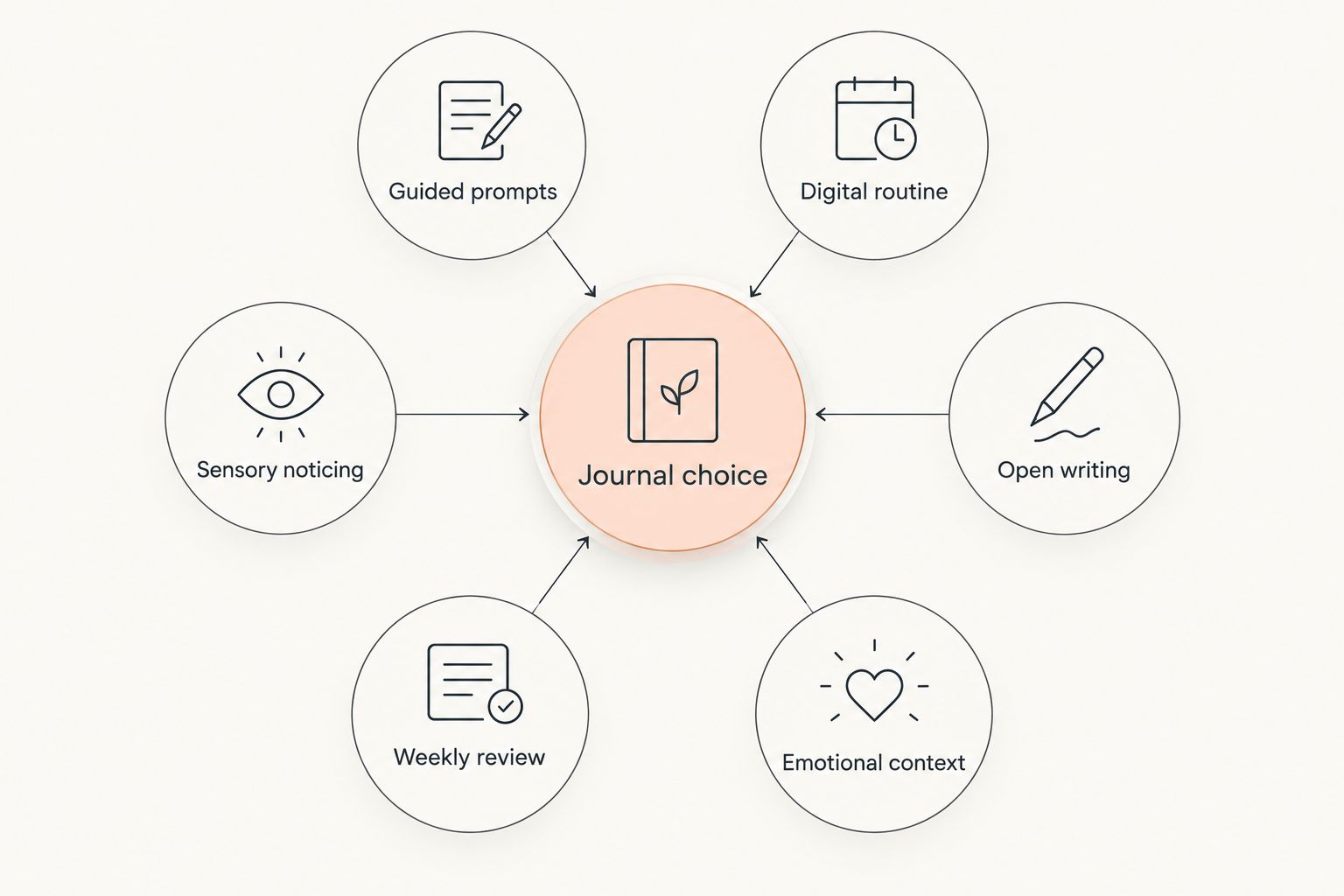
Use these decision points:
- Guided prompts: Choose structure when deciding what to write is the barrier.
- Digital routine: Choose a digital journal when screen-based reflection already fits your day.
- Open writing: Choose a notebook when prescribed questions restrict your thoughts.
- Emotional context: Choose a combined layout when feelings belong beside appreciation.
- Weekly review: Choose a review page when you want to examine recurring themes.
- Sensory noticing: Choose observation prompts when abstract questions feel distant.
Keep your first routine small: name the moment, describe a detail, and explain why you appreciated it. Stop there if that is enough. Your journal does not need to become a second planning system.
FAQ
What's the best gratitude journal for mindfulness in 2026?
An undated guided gratitude journal is the best default for beginners who want structure without fixed dates. Choose prompts that ask for a specific moment and why it mattered, with room for mixed feelings.
Is a digital gratitude journal better than a paper notebook?
A digital gratitude journal is better for an existing digital writing routine; a paper notebook is better when you want to write away from a device. Choose by how easily you can begin an entry, not by the format's appearance.
Does Wanderingsweetsoul sell digital self-care journals?
Wanderingsweetsoul offers digital self-care journals, planners, and workbooks. Check the individual journal's description and page previews to confirm that its prompts suit gratitude and mindfulness.
What should I write in a gratitude journal?
Write about a specific moment you appreciated, describe a detail, and explain why it mattered. A concrete interaction or observation gives you more to reflect on than a general list of things you like.
How long should a daily gratitude entry take?
Start with a 2-minute entry if you want a manageable routine. That is a practical starting limit, not a required duration or a promise of benefits.
Can I write about a difficult day in a gratitude journal?
Yes, a gratitude journal can include a difficult day without rewriting it as a positive experience. Record what was hard and any genuine appreciation separately; do not force an answer.
Do I need to write in my gratitude journal every day?
No, you do not need an unbroken daily streak to use a gratitude journal. For daily mindfulness, a brief observation can accompany a longer weekly review, and undated pages let you resume after a gap.
One last thing
Before committing to a journal in 2026, answer one sample prompt without decorating the page or planning a new routine. If the question makes sense and gives you something honest to write, the format has passed its most useful check. Choose a page you can use on a difficult day, not just one you admire on a good day.