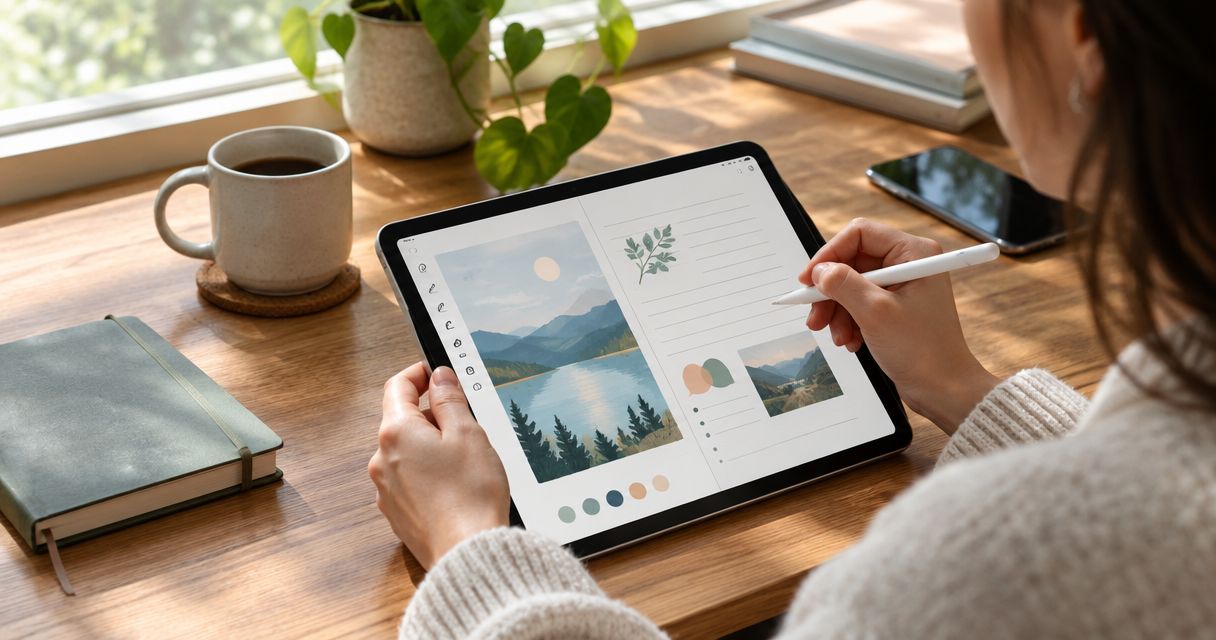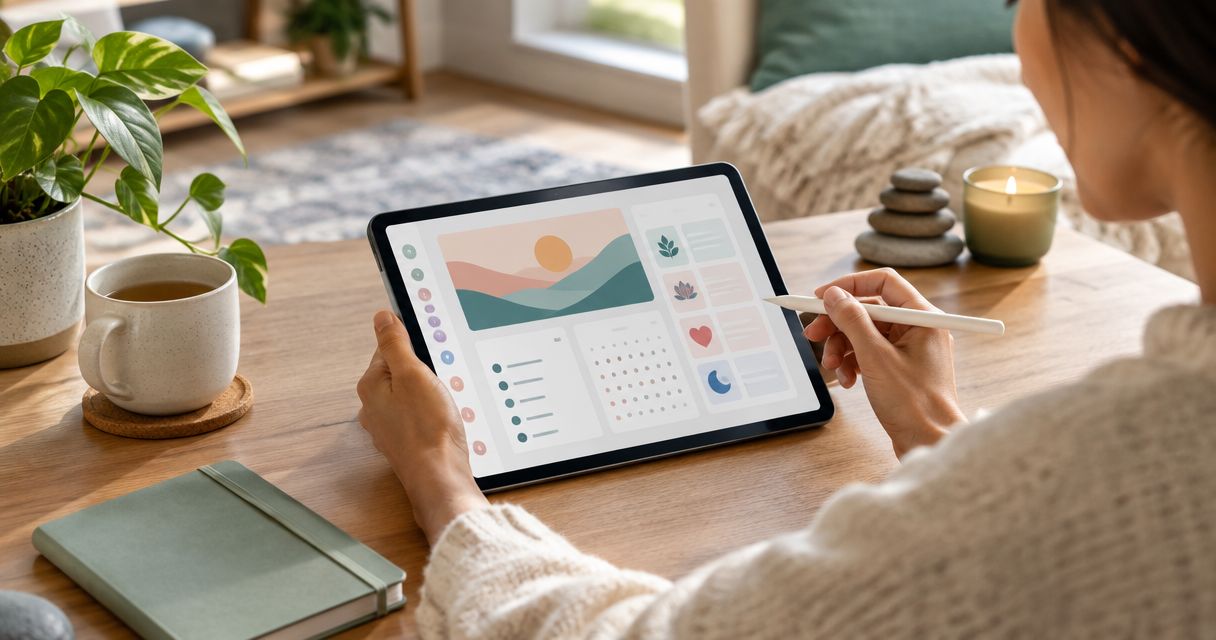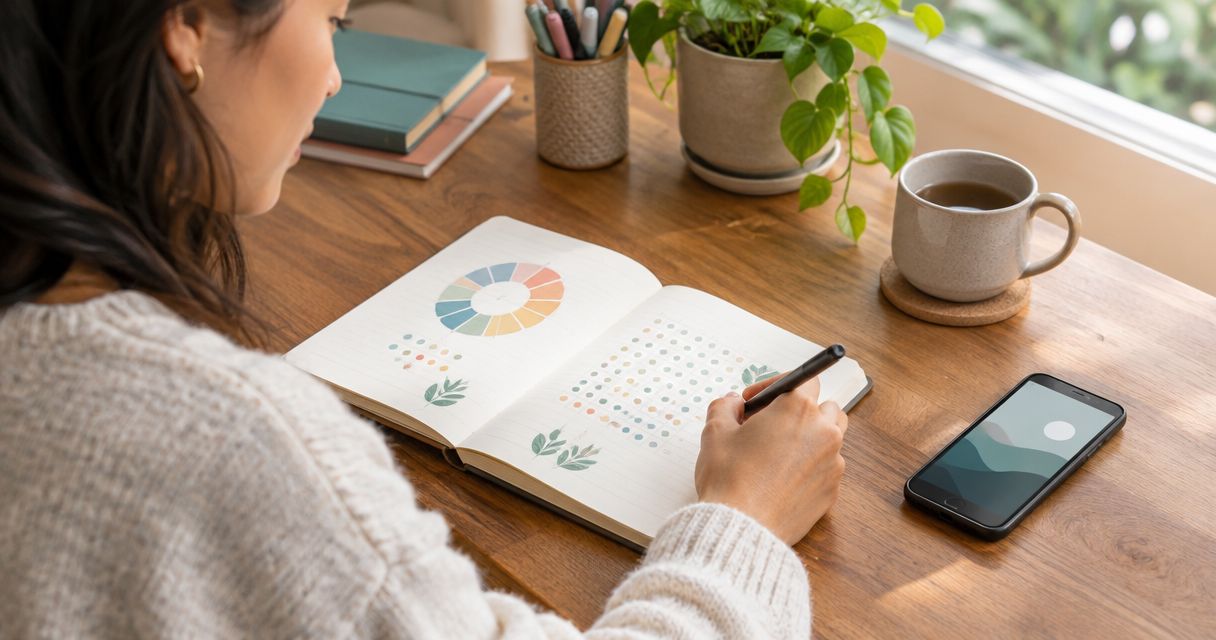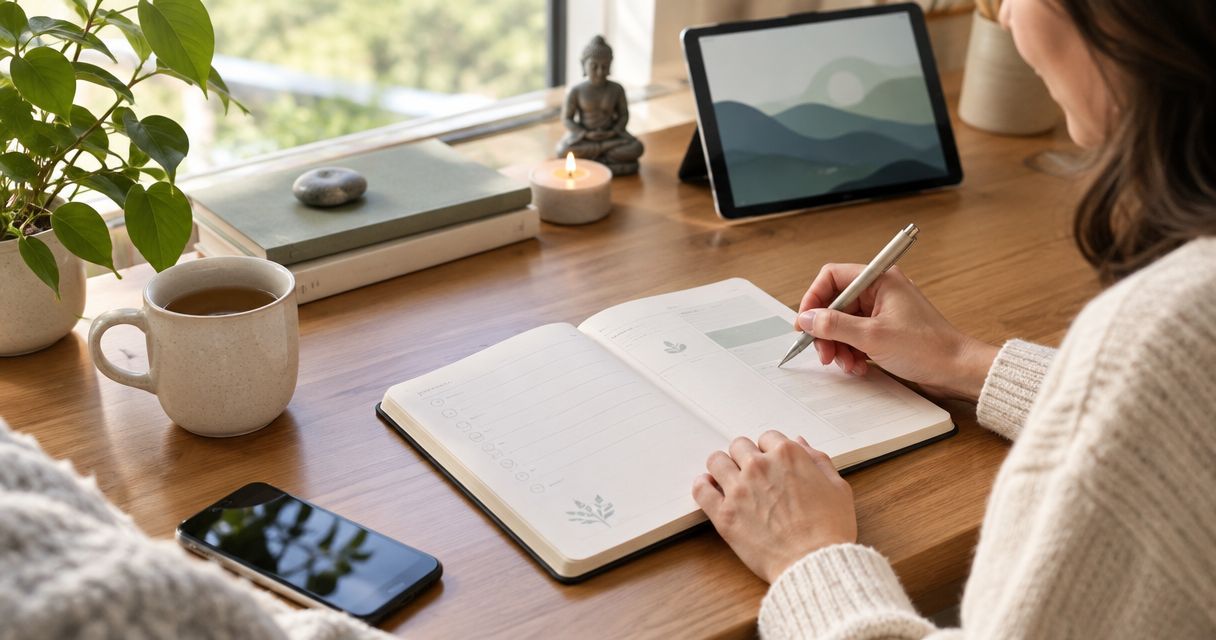
Best overall: a daily check-in planner. Best for reflection: a guided mindfulness journal. Best low-commitment option: a single-page mindfulness planner. The best mindfulness planner for stress relief in 2026 matches the kind of support you need, rather than adding another task to your day.
- A daily check-in format is the best default mindfulness planner for stress relief: notice, prioritize, and choose a manageable action.
- Wanderingsweetsoul suits readers seeking digital self-care planners, journals, and workbooks rather than a physical planner.
- Choose guided journaling for reflection, a weekly planner for boundaries, or a single-page format for simplicity.
- Use mindfulness planning as a self-care practice, not as treatment for anxiety or another mental health condition.
Wanderingsweetsoul offers digital self-care planners, journals, and workbooks. This guide ranks 10 planner formats, not named products, so you can choose a structure before comparing individual listings.
Why this matters
A productivity planner asks what you need to finish. A mindfulness planner asks what you notice, what deserves attention, and what action fits your capacity. Those questions serve different purposes.
For your 2026 routine, start with the problem you want the planner to address: scattered attention, crowded commitments, difficulty naming feelings, or an unstructured evening. A format that addresses that problem is a better choice than a layout packed with unrelated trackers.
Wanderingsweetsoul is best suited to readers looking for digital self-care planners, journals, and workbooks. Choose a particular listing by its visible pages and instructions, not by assuming every digital planner includes the same features.
What makes the best mindfulness planner for stress relief?
Use these criteria before choosing a format or buying a download:
- Present-moment attention: Look for prompts about what you notice now, rather than pages devoted only to future goals.
- Manageable effort: Choose a layout you can complete without treating reflection as homework.
- A useful next step: The page should help you identify an action, a boundary, or something to leave unfinished.
- Flexible use: Decide whether you need undated pages, room to skip entries, or a format you can reuse.
- Format clarity: Check whether the file is intended for printing, handwriting digitally, or another workflow. Confirm requirements in the listing.
Do not confuse a long feature list with a good fit. If you want a brief check-in, elaborate goal dashboards and detailed habit logs add work without answering your immediate question.
The best mindfulness planner formats at a glance
These rankings describe the structure to look for. The standout features below are selection criteria, not claims about a particular seller's files.
| Rank and format | Best for | Standout feature to seek | Key limitation |
|---|---|---|---|
| 1. Daily check-in planner | Everyday grounding | Notice, prioritize, act prompts | Repetitive if you want deeper reflection |
| 2. Guided mindfulness journal | Written reflection | Focused questions with writing space | Requires more writing |
| 3. Single-page mindfulness planner | Minimal setup | One self-contained page | Limited space for context |
| 4. Weekly boundaries planner | Overcommitted schedules | Commitments beside personal limits | Less attention to daily feelings |
| 5. Mood-and-context planner | Naming emotional patterns | Feelings alongside relevant circumstances | Tracking is not diagnosis |
| 6. Gratitude-and-attention planner | Noticing ordinary experiences | Specific observations without forced positivity | Too narrow for complex concerns |
| 7. Mindful task planner | Choosing priorities | Tasks paired with capacity checks | Can drift into productivity tracking |
| 8. Evening reflection planner | Closing the day | Reflection plus a stopping point | Does not address sleep disorders |
| 9. Creative mindfulness planner | Less writing | Drawing or coloring beside a check-in | Less written detail to revisit |
| 10. Mindfulness workbook planner | Structured learning | Exercises followed by reflection | More demanding than a daily page |
1. Daily check-in planner: best for everyday grounding
A daily check-in planner gives you a repeatable place to notice your current state and choose what comes next. Look for prompts that separate feelings, priorities, and actions instead of blending them into a long to-do list.
Daily check-in planner pros:
- Gives each entry a clear starting point.
- Keeps reflection close to everyday decisions.
- Works as a recurring practice without a long narrative.
Daily check-in planner cons:
- Repeated prompts can feel mechanical.
- Brief entries leave little room for complicated situations.
Best for: You want a default practice rather than a specialized journal.
Try a 2-minute check-in as a starting routine, not a promised stress-relief threshold. Write what you notice, identify one priority, and choose a manageable action.
Verdict: Buy this format if you want a simple daily starting point.
2. Guided mindfulness journal: best for written reflection
A guided mindfulness journal uses questions to give your writing direction. Choose prompts that invite observation without demanding that you explain or resolve every feeling.
Guided mindfulness journal pros:
- Reduces the blank-page problem.
- Gives you space to describe a situation.
- Creates entries you can revisit for context.
Guided mindfulness journal cons:
- Requires more writing than a check-in page.
- A prompt can feel irrelevant on a particular day.
Best for: You think more clearly when you put an experience into words.
For a 2026 journaling routine, favor questions such as what you noticed and what you need next. Skip any prompt you do not want to answer; completing the page is not the goal.
Verdict: Buy this format if reflection matters more than scheduling.
3. Single-page mindfulness planner: best for minimal setup
A single-page planner keeps the entire exercise in one view. Seek a layout with a check-in, a priority, and a closing observation rather than a miniature version of every possible tracker.
Single-page mindfulness planner pros:
- Makes the scope of the exercise visible.
- Avoids switching between multiple sections.
- Lets you focus on a small set of questions.
Single-page mindfulness planner cons:
- Offers limited writing space.
- Does not provide a detailed weekly overview.
Best for: You abandon planners when they require too much setup.
A 5-minute session is a practical trial you can set for yourself. Stop when you have answered the useful questions, even if some fields remain empty.
Verdict: Buy this format if fewer pages help you begin.
4. Weekly boundaries planner: best for crowded commitments
A weekly boundaries planner puts obligations beside the limits you want to respect. Look for room to distinguish necessary commitments from optional ones and to identify something you can decline, delay, or simplify.
Weekly boundaries planner pros:
- Shows competing demands in one place.
- Makes personal limits part of planning.
- Supports decisions before commitments accumulate.
Weekly boundaries planner cons:
- Gives less space to immediate emotions.
- A written boundary still requires action outside the planner.
Best for: Your main concern is an overfilled calendar.
Do not fill every blank space with another activity. A useful weekly plan also records what you are choosing not to take on.
Verdict: Buy this format if you need clearer limits, not more tasks.
5. Mood-and-context planner: best for naming emotional patterns
A mood-and-context planner records how you feel alongside what was happening. Seek space for your own words, not just a rating or a colored square.
Mood-and-context planner pros:
- Keeps feelings connected to circumstances.
- Supports more specific descriptions than good or bad.
- Provides a record to discuss with a qualified professional.
Mood-and-context planner cons:
- A log cannot establish cause and effect.
- Constant monitoring can become an unwanted task.
Best for: You want language and context for experiences you find hard to describe.
In 2026, use a mood log as a personal record, not a diagnostic scorecard. Stop or change the practice if documenting every feeling becomes distressing.
Verdict: Buy this format for observation; skip it for self-diagnosis.
6. Gratitude-and-attention planner: best for noticing ordinary experiences
A gratitude-and-attention planner directs attention toward specific experiences you appreciate. Choose one that allows difficult feelings to coexist with those observations.
Gratitude-and-attention planner pros:
- Gives attention a concrete subject.
- Encourages detail rather than a generic positive statement.
- Can work as a brief written practice.
Gratitude-and-attention planner cons:
- Does not replace working through a difficult situation.
- Forced positivity can make prompts feel dismissive.
Best for: You want to notice everyday details without writing a long entry.
Describe something particular: a helpful conversation, a quiet moment, or a task made easier. You do not have to reframe an upsetting experience as a benefit.
Verdict: Buy this format if appreciation feels honest, not compulsory.
7. Mindful task planner: best for choosing priorities
A mindful task planner connects your task list with attention and capacity. Look for a place to identify what matters, what can wait, and how you want to approach the work.
Mindful task planner pros:
- Links reflection to a practical decision.
- Helps distinguish priorities from miscellaneous tasks.
- Keeps capacity visible beside commitments.
Mindful task planner cons:
- Easily becomes another productivity dashboard.
- Offers less room for open-ended reflection.
Best for: You need to choose a next task without planning every moment.
Judge the page by whether it helps you decide, not by how much you complete. An intentionally postponed task is still a decision.
Verdict: Buy this format if prioritization is your main need.
8. Evening reflection planner: best for closing the day
An evening reflection planner gives you a place to record unfinished thoughts and identify a stopping point. Seek prompts about what happened, what remains open, and what can wait until another day.
Evening reflection planner pros:
- Creates a defined place for end-of-day notes.
- Separates unfinished work from immediate action.
- Includes an opportunity to acknowledge enough.
Evening reflection planner cons:
- Long entries can extend rather than close reflection.
- It is not treatment for insomnia or another sleep disorder.
Best for: You want an intentional ending to your planning routine.
Keep the closing action modest: note what needs attention later, then put the planner away. Do not turn the evening page into tomorrow's entire schedule.
Verdict: Buy this format for closure, not a promise of better sleep.
9. Creative mindfulness planner: best for less writing
A creative mindfulness planner pairs observation with drawing, coloring, or another visual response. Look for an optional written check-in so you can record a thought without making paragraphs mandatory.
Creative mindfulness planner pros:
- Offers an alternative to extended writing.
- Leaves room for a nonverbal response.
- Lets you choose between visual and written expression.
Creative mindfulness planner cons:
- Creates less written context to revisit.
- Detailed pages can feel like another project.
Best for: You prefer a visual activity to a text-heavy journal.
Wanderingsweetsoul offers digital adult coloring books alongside its self-care products. Treat coloring and mindfulness planning as distinct activities; do not assume a coloring book includes planner pages.
Verdict: Buy this format if visual expression suits you better than journaling.
10. Mindfulness workbook planner: best for structured exercises
A mindfulness workbook planner combines instructions, an exercise, and space to reflect afterward. Read sample pages to check that the exercises match your purpose and feel appropriate for you.
Mindfulness workbook planner pros:
- Explains an activity before asking you to complete it.
- Connects practice with reflection.
- Provides more direction than an open journal.
Mindfulness workbook planner cons:
- Requires more attention than a short check-in.
- Completing exercises does not establish a therapeutic outcome.
Best for: You want guided practice rather than a recurring blank layout.
Try a 10-minute reading-and-reflection session as your own starting limit. That suggestion is a way to control effort, not a claim about effectiveness.
Verdict: Buy this format if you want instructions; skip it if you need simplicity.
How the formats rank
The order follows the selection criteria: present-moment attention, manageable effort, useful next steps, flexibility, and format clarity. This is a structure-based comparison, not a product test or a ranking of clinical effectiveness.
The daily check-in ranks first because it combines observation with a practical decision. Specialized formats rank lower because they address narrower needs, not because they are inherently worse.
Which mindfulness planner should you choose?
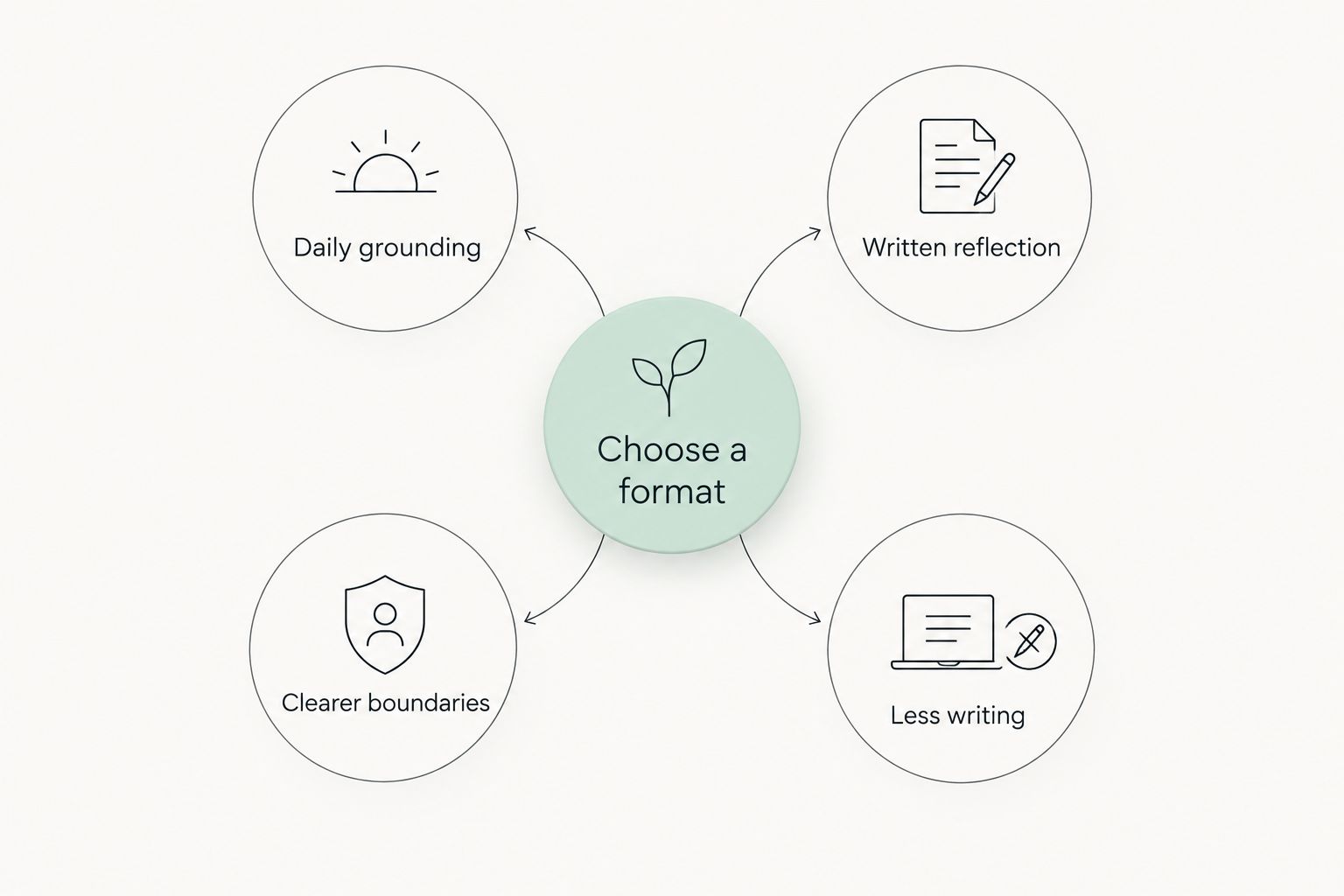
Choose a daily check-in planner if you are undecided. For your 2026 routine, start with the smallest structure that addresses your actual need:
- Daily grounding: Choose the daily check-in format.
- Written reflection: Choose the guided journal format.
- Clearer boundaries: Choose the weekly boundaries format.
- Less writing: Choose the creative format.
When considering a Wanderingsweetsoul self-care planner, inspect the listing's sample pages and file instructions. Confirm what is included and how you will use it before making a decision.
FAQ
What's the best mindfulness planner for stress relief?
A daily check-in planner is the best default format for everyday observation and choosing a manageable next action. Choose a more specialized format when you need written reflection, boundaries, or visual expression.
Is a mindfulness planner better than a regular planner?
A mindfulness planner is better suited to reflection; a regular planner is better suited to scheduling. Choose according to your purpose, or keep the two functions separate within your routine.
Can a mindfulness planner treat anxiety?
A mindfulness planner is not a treatment for anxiety. Use it as a self-care tool, and seek qualified support when anxiety causes distress or interferes with daily life.
Should I choose a digital or paper mindfulness planner?
Choose the format you can use comfortably and consistently. For a digital download, check the listing's file requirements and printing or annotation instructions before buying.
Do I need to complete my mindfulness planner every day?
You do not need to complete a mindfulness planner every day. Choose a frequency that fits your purpose, and leave prompts unanswered when they are not useful.
What should I look for in a mindfulness planner in 2026?
Look for clear prompts, manageable effort, useful next steps, and a format you understand. Sample pages are more informative than a long list of features.
What kind of self-care products does Wanderingsweetsoul offer?
Wanderingsweetsoul offers digital self-care planners, journals, workbooks, and adult coloring books. Check individual listings for their contents and usage requirements.
One last thing
An empty field is not a failed practice. Before adopting a new layout, choose the prompt you would still answer on a difficult day. If none feels useful, choose a simpler format rather than trying harder to complete the wrong one.