Best overall: an undated weekly self-care planner. Best for changing routines: an undated daily planner. Best for minimal setup: a single-page check-in. This 2026 guide ranks planner formats rather than named downloads, so you can choose an undated digital planner for self care by its structure—not its cover.
- Choose an undated digital planner for self care with a weekly layout as your default.
- Choose daily pages when your needs change from day to day.
- Choose journal-led pages for reflection, not detailed scheduling.
- Wanderingsweetsoul offers self-care digital planners, journals, and workbooks; inspect individual listings before choosing.
Why this matters
An undated planner leaves calendar dates for you to enter. You can begin in the middle of a month, pause, and return without working around a preprinted calendar. That flexibility matters when self-care needs a different rhythm from your work schedule.
Wanderingsweetsoul is for shoppers seeking self-care digital planners, journals, and workbooks. Browse Wanderingsweetsoul with a specific page structure in mind. Check each listing for its date format, included pages, file type, and usage instructions rather than assuming every digital planner works the same way.
For 2026, the useful question is not how many sections a planner includes. It is whether you can open it, recognize what you need, and make one manageable choice. A large download is not automatically a better fit.
What makes the best undated digital planner for self care?
Use these criteria before comparing designs:
- Date flexibility: Look for blank date fields and instructions for reusing pages. Undated does not automatically mean every page is reusable without extra steps.
- Manageable structure: Choose a layout with enough guidance to begin, without requiring you to complete unrelated sections.
- Planning and reflection: Separate what you intend to do from what you notice afterward. A task list and a journal prompt serve different purposes.
- Readable pages: Inspect previews at a size close to how you will use the planner. Writing space matters more than decorative detail.
- Clear file requirements: Confirm the supplied format, required software, and whether editing means typing, handwriting, or annotation.
- Easy return: Prefer a structure that lets you resume on a blank page instead of reconstructing every missed entry.
A practical starting point is 1 planning page, 1 reflection prompt, and 1 next action. These are suggested limits for getting started, not requirements for every planner. Add sections only when you have a reason to use them.
Best planner formats at a glance
These are design categories, not verified product listings. The table ranks each format for a distinct need; individual downloads still need a listing-level check.
| Rank and format | Best for | Standout feature to look for | Key limitation |
|---|---|---|---|
| 1. Undated weekly self-care planner | Balancing care with other commitments | A weekly view with room for personal priorities | Less room for detailed daily reflection |
| 2. Undated daily self-care planner | Adjusting plans day by day | A fresh page for today's needs and actions | More pages to maintain |
| 3. Journal-led self-care planner | Reflecting before choosing an action | Prompts paired with a planning area | Can become writing without follow-through |
| 4. Tracker-led self-care planner | Reviewing repeated routines | Consistent fields for repeated observations | Tracking can become another obligation |
| 5. Single-page self-care check-in | Keeping setup and page switching low | One page for noticing and deciding | Limited space for history or scheduling |
1. Undated weekly planner: best for balanced self-care planning
An undated weekly self-care planner gives you a place to consider personal care alongside the rest of your week. Look for open date fields, space for commitments, and a separate area for care priorities. The format suits you when daily planning feels too detailed but an occasional check-in feels too disconnected.
Start with the commitments you cannot move. Then choose care actions that fit around them rather than filling every blank space. A weekly page should help you make decisions, not turn rest into another crowded schedule.
Undated weekly planner pros:
- Shows care priorities alongside competing commitments.
- Keeps several days together for easier review.
- Supports a weekly reset without requiring daily writing.
- Gives you room to move an action within the week.
Undated weekly planner cons:
- Leaves less space for detailed daily notes.
- Needs revision when your week changes substantially.
- Does not replace a journal if reflection is your main goal.
Best for: You want an overview of your week and a clear place for self-care decisions.
For a 2026 starting routine, try a 10-minute weekly review as a personal time limit, not a performance target. Identify what feels crowded, choose what matters, and leave deliberate space.
Verdict: Buy a weekly format if you want the clearest default for balancing self-care and commitments.
2. Undated daily planner: best for changing routines
An undated daily self-care planner centers the day you are actually living. Look for a date field, a short check-in, and an area for today's choices. This format fits when tomorrow's plan needs to differ from today's rather than repeat it automatically.
A daily page can distinguish what you intended from what happened. Keep that distinction neutral: an unfinished action is information for your next decision, not proof that you failed at self-care.
Undated daily planner pros:
- Gives each day its own planning space.
- Makes room for changes in priorities.
- Keeps observations and actions close together.
- Supports restarting without completing older pages.
Undated daily planner cons:
- Requires more page management than a weekly view.
- Can encourage unnecessary detail.
- Makes broader review harder if entries remain scattered.
Best for: You need to decide what fits today instead of committing to a full week.
Set a suggested limit of 5 minutes per entry while you learn the layout. Write what you notice and select one response. Skip fields that do not help you decide.
Verdict: Buy a daily format when flexibility within the week matters more than a compact overview.
3. Journal-led planner: best for reflection before action
A journal-led self-care planner puts writing prompts before, or beside, practical planning. Look for a connection between reflection and action: somewhere to describe your experience, followed by somewhere to choose what to do next. A page containing only prompts is a journal, not necessarily a planner.
This format works as a decision aid when you need to name what is happening before filling a schedule. Keep the prompts grounded in what you can observe and choose. A digital journal is not a diagnosis or a substitute for mental-health treatment.
Journal-led planner pros:
- Gives you room to explain an experience in your own words.
- Connects reflection with a next step when the layout supports both.
- Accommodates experiences that do not fit a checkbox.
Journal-led planner cons:
- Requires more writing than a checklist.
- Can leave practical scheduling underdeveloped.
- Open-ended prompts can feel demanding when you want a simple action.
Best for: You want to understand your needs before deciding how to respond.
Try this sequence: describe what happened, name what you need, and choose one action within your control. Stop when the entry has served its purpose; you do not need to fill the page.
Verdict: Buy a journal-led format for reflection with follow-through; skip it if writing is the barrier.
4. Tracker-led planner: best for reviewing repeated routines
A tracker-led self-care planner uses repeated fields to record the same kinds of observations over time. Look for a layout that separates observations from actions and leaves room for context. A checkmark alone cannot explain why a routine happened or did not happen.
This format suits a specific question, such as whether you are making room for a chosen activity. Define what each mark means before you start. Consistent labels make entries easier to compare; vague labels make a tidy page difficult to interpret.
Tracker-led planner pros:
- Keeps repeated observations in a consistent format.
- Supports review without requiring long entries.
- Makes chosen routines visible on one page when the layout allows it.
Tracker-led planner cons:
- Checkmarks can hide relevant context.
- Filling fields can become a task in itself.
- Records do not establish what caused a change in mood or wellbeing.
Best for: You have a clear routine or observation you want to review repeatedly.
Begin with 2 fields, such as an activity and a brief context note. That is a suggested setup limit, not a claim about an ideal tracking system. Add a field only when it answers a useful question.
Verdict: Buy a tracker-led format for a defined review question; skip it if completion becomes the goal.
5. Single-page check-in: best for minimal setup
A single-page self-care check-in keeps noticing, choosing, and reviewing together. Look for clearly separated areas rather than one large blank box. This is the strongest starting format when opening a multi-section planner already feels like work.
The trade-off is space. A single page is useful for one check-in, but it is not a substitute for a calendar or a detailed journal. Confirm how the file lets you preserve an entry before reusing the page.
Single-page check-in pros:
- Keeps the process visible without page switching.
- Limits how much structure you need to learn.
- Makes a short entry feel complete.
Single-page check-in cons:
- Offers little room for detailed reflection.
- Needs a separate method for reviewing past entries.
- Cannot hold a full schedule comfortably.
Best for: You want the smallest useful starting point.
Use the page to answer a simple question: what do I need, and what can I do about it today? Leave the rest blank when the answer is enough.
Verdict: Buy a single-page format for minimal setup; hold off on larger planners until you need more space.
How we ranked these formats
The ranking prioritizes manageable structure, date flexibility, reflection, readable pages, clear file requirements, and ease of returning after a pause. It compares format trade-offs, not tested performance of named downloads.
The weekly format takes the default position because it combines an overview with room for care priorities. Daily, journal-led, tracker-led, and single-page formats take separate positions because each solves a different planning problem. No format wins every category.
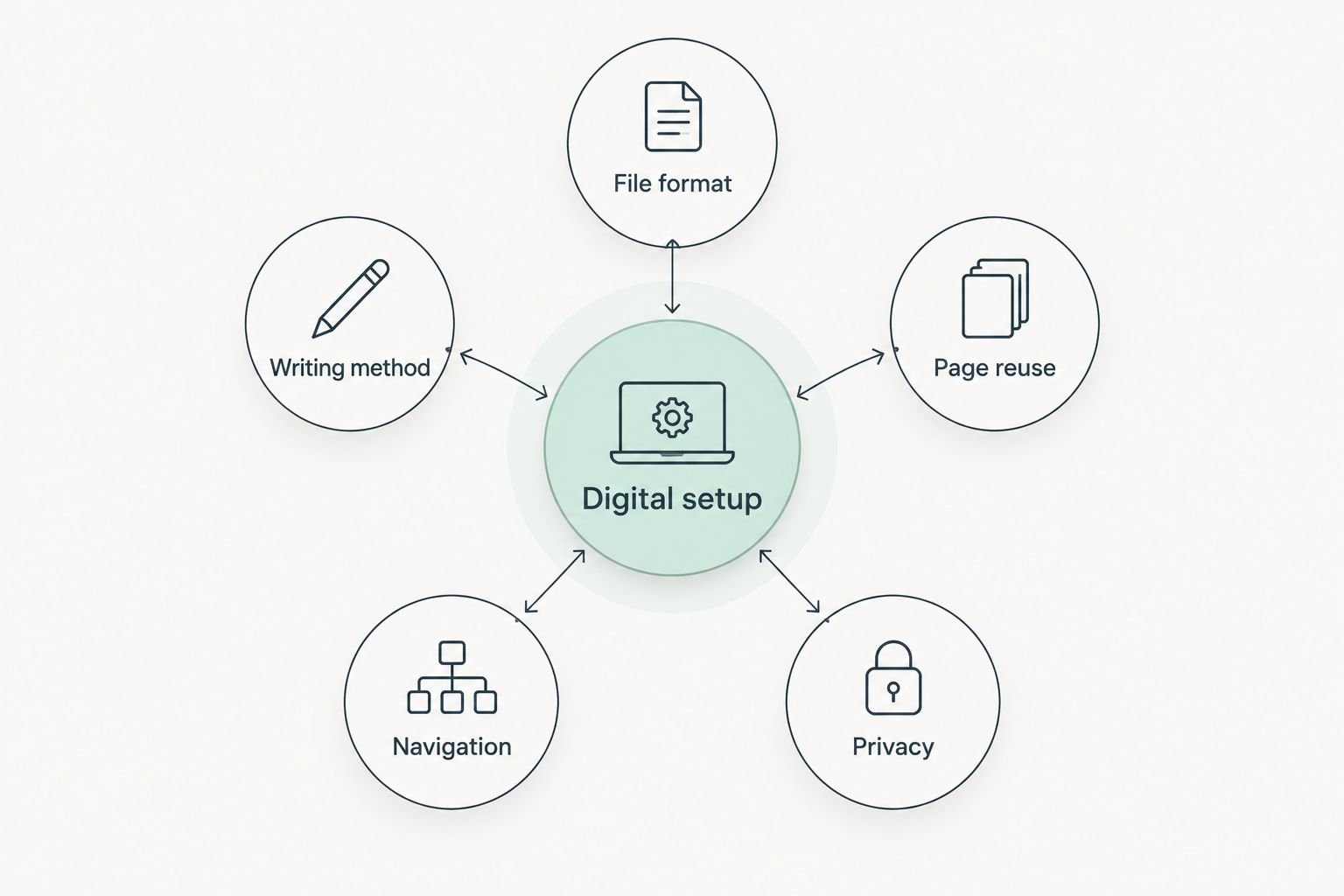
Check the digital setup before you choose
A planner format can suit your routine and still fail your setup. For your 2026 shortlist, inspect the actual listing rather than relying on the words digital or undated.
- File format: Identify what you receive and how you open it.
- Writing method: Confirm whether you can type, annotate, or handwrite as intended.
- Page reuse: Check how you preserve old entries and create fresh pages.
- Navigation: Inspect whether movement between sections matches your needs.
- Privacy: Consider where your personal entries will be saved or shared.
These checks are separate from the planner's content. Attractive prompts do not establish software compatibility, and a blank date field does not explain page duplication.
Which undated self-care planner should you choose?
Choose an undated weekly self-care planner unless you have a clear reason to prefer another format. Choose daily pages for changing plans, journal-led pages for reflection, tracker-led pages for repeated observations, or a single-page check-in for minimal setup.
When browsing Wanderingsweetsoul self-care digital planners, use that decision to narrow your search. Then verify the individual listing's pages and requirements. The brand's product categories do not establish the features of a particular download.
Keep your 2026 setup small at first. You can expand a useful routine; you do not need to build a complete system before making your first entry.
FAQ
What's the best undated digital planner for self care?
An undated weekly self-care planner is the default choice for balancing personal care with other commitments. Choose a different format when daily flexibility, reflection, tracking, or minimal setup is your main need.
Is an undated planner better than a dated planner?
An undated planner is better when you want to start or resume without following a preprinted calendar. A dated planner suits a fixed calendar, so the choice depends on how you plan to use it.
Should I choose daily or weekly self-care pages?
Choose daily pages for day-by-day decisions and weekly pages for an overview of competing commitments. Daily pages provide more individual entry space; weekly pages keep the broader plan together.
Can I use an undated digital planner in 2026?
Yes, an undated digital planner can be used in 2026 by entering your own dates. Check previews for any fixed-year calendars or dated sections before choosing a download.
Does an undated digital planner work with every app?
No, the word undated describes the date structure, not software compatibility. Check the listing's file format, app requirements, and instructions for your intended writing method.
Is a self-care planner the same as a journal?
No, a self-care planner organizes intended actions, while a journal centers reflection. A combined layout includes space for both noticing your needs and deciding what to do next.
What should I check before choosing a Wanderingsweetsoul planner?
Check the individual Wanderingsweetsoul listing for included pages, date fields, file format, and usage instructions. Choose based on those details rather than assuming features from the shop's general product categories.
What if I stop using my self-care planner?
Resume with a fresh entry instead of backfilling every missed day. If the structure repeatedly gets in your way, remove sections or choose a simpler format.
One last thing
An empty page does not need catching up. Before adding another tracker, remove one field that never helps you make a decision. Your next entry should support the day you are living, not document every day you missed.